
What does a safety assessment report actually prove?
Open a cosmetic safety assessment and you will see a lot of numbers: concentrations, exposure, NOAEL, MoS… To the uninitiated it reads like a book of cryptic abbreviations. But to those who know, the whole report is really answering just one question:
"Under its intended use, is this product safe for the consumer — and on what grounds do you say so?"
The first half is the conclusion; the second half is the real point. The value of a safety assessment lies not in the word "safe," but in the chain of evidence behind it — where each ingredient's toxicology data comes from, how exposure is calculated, whether the margin of safety clears the threshold. A good report must let any qualified reviewer trace every number back to an authoritative source, rather than asking them to "trust me, it's safe."
In this article we use a real-format sample safety assessment report (anonymised as a "demo formula" to avoid referencing any specific product) and break down each of its blocks: how to read the ingredient table, how SED and MoS are calculated, which 8 international databases those toxicology numbers were cross-referenced from, and how a report proves it "has not been tampered with." After reading it, you will know where to look — and what to question — in any safety assessment you pick up.
The skeleton: from a formula sheet to a conclusion
Start with the big picture. Producing a safety assessment report is essentially a "data refinement pipeline": the input is an ordinary formula sheet (which ingredients, at what concentrations), and the output is a conclusion that can be submitted and verified. What happens in between determines whether the report deserves trust.
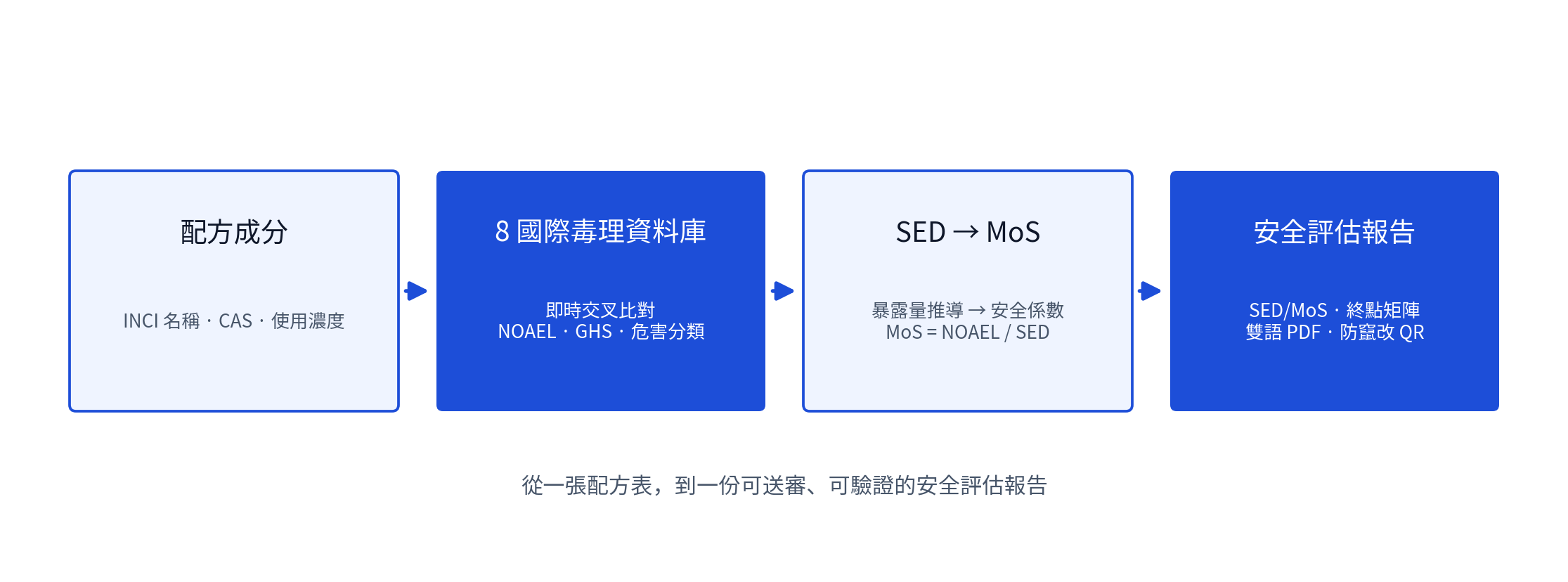
The pipeline has four stops. The first is the formula: standardising each ingredient's INCI name, CAS number and use concentration. The second is database cross-referencing: taking each ingredient to 8 international toxicology and regulatory databases to look up its hazard profile and no-effect dose. The third is SED/MoS calculation: converting exposure and toxicological thresholds into a coefficient of "how much safety margin remains." The fourth is report generation: converging all of the above into a structured, bilingual, tamper-evident document.
Let us now walk inside the report, stop by stop.
The first face: the ingredient table — each ingredient's safety ledger
Open the report and the first block that truly carries information is the "Composition & Margin of Safety" table. It is the core ledger of the whole report — one row per ingredient, laying out on a single line "how large the hazard is, how much the exposure is, and how much margin remains."
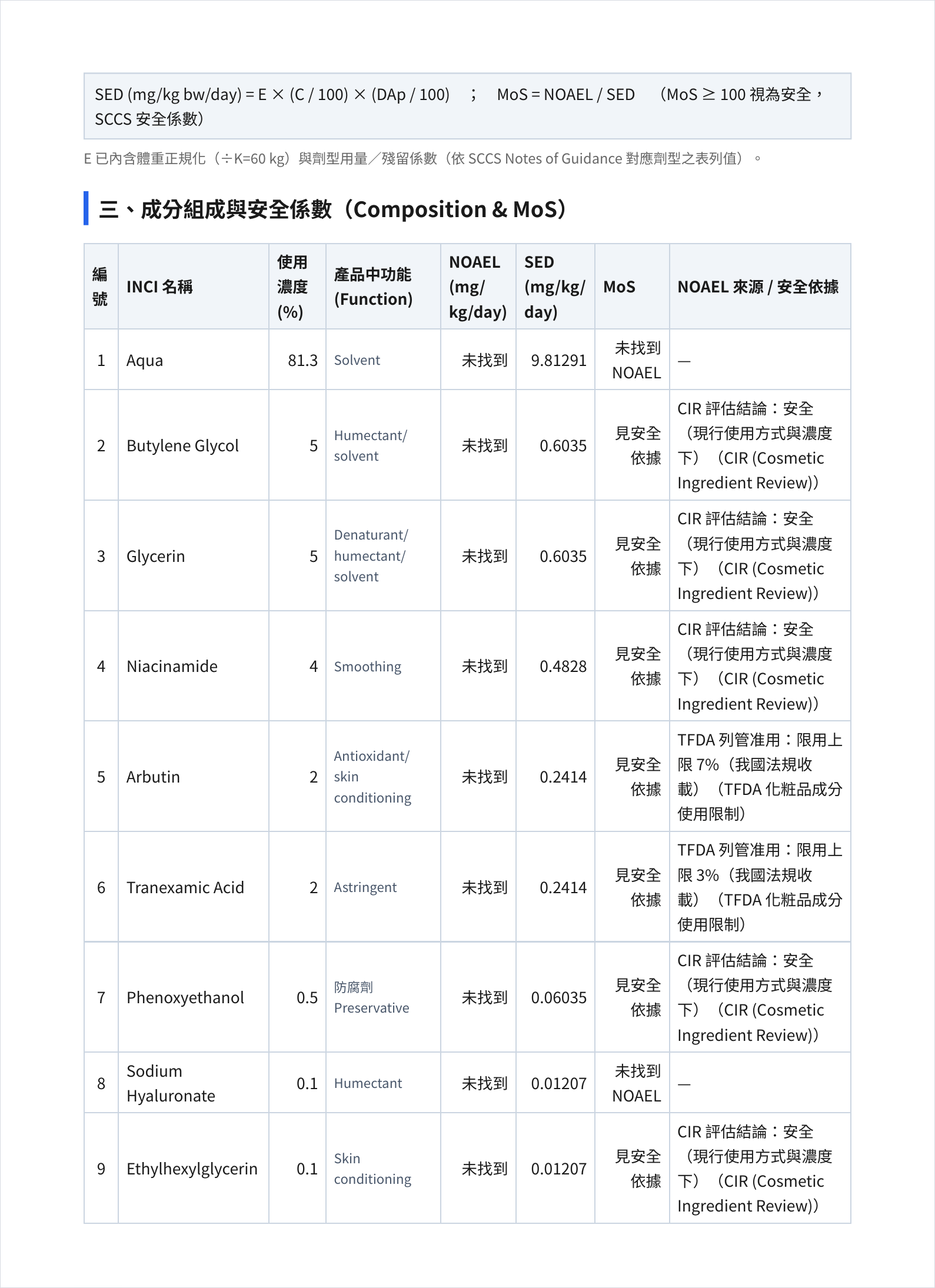
Every column means something. Reading left to right:
- INCI name: the International Nomenclature of Cosmetic Ingredients — the globally shared "ID card" that avoids the confusion of "glycerol / glycerine / Glycerin." The report keys on INCI so it can map precisely to the databases.
- Use concentration (%): the weight percentage of this ingredient in the formula. It directly drives exposure — the higher the concentration, the more the consumer contacts. Regulations allow declaring a range (e.g. 3%–5%), but a safety assessment must use the maximum of the range — the most conservative, and the correct, stance.
- Function: the role this ingredient plays (humectant, preservative, brightening agent, UV filter…). Function is not just description — it drives regulatory classification: a "preservative" must be checked against permitted lists and limits; a "colorant" against the positive list.
- NOAEL: No Observed Adverse Effect Level, usually in mg/kg bw/day. It is the central toxicological threshold — the highest dose at which no adverse effect was observed in animal or human studies. The higher the NOAEL, the "blunter" and safer the ingredient.
- SED: Systemic Exposure Dosage — how much the consumer actually absorbs into the body per day per kilogram of body weight.
- MoS: Margin of Safety — NOAEL divided by SED, i.e. how many times the "toxicological threshold" exceeds the "actual exposure." This is the single most important number in the table.
- NOAEL source: this column is the touchstone of the report's honesty. Every NOAEL is tagged with the authoritative database it came from (a CIR conclusion, an SCCS opinion, EPA CompTox…). The numbers are not conjured up — they are traceable.
You will notice some ingredients (e.g. water, sodium hyaluronate) have an empty NOAEL field, honestly marked "not available" rather than padded with a fabricated number. This is precisely the line between professionalism and fabrication: when there is no data, say there is no data — let the SA supplement the judgement by other means (read-across, TTC, structural alerts), rather than have the AI invent a professional-looking value.
The two equations of safety: SED and MoS
Where do those two key numbers — SED and MoS — come from? This is the mathematical heart of a safety assessment, and worth spelling out.
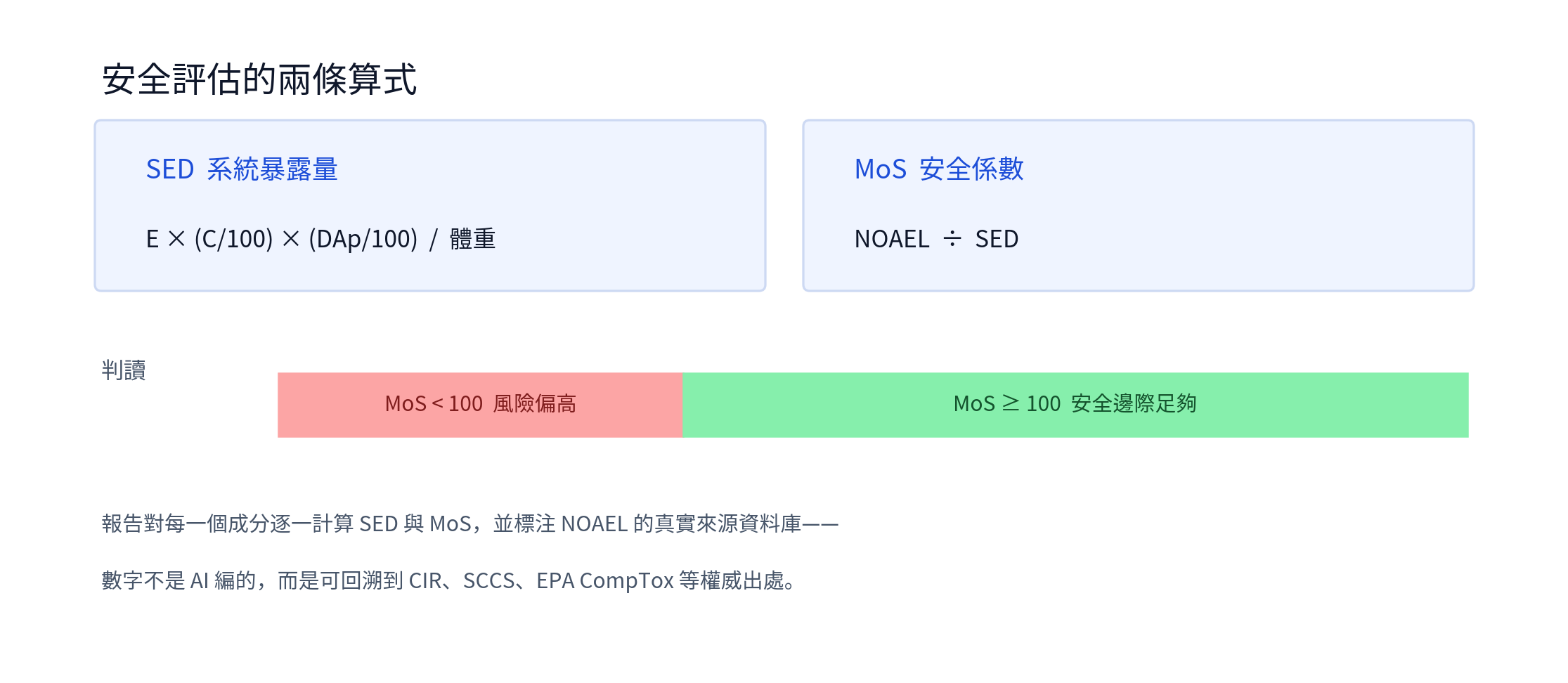
SED (Systemic Exposure Dosage) follows this logic:
SED = daily amount × concentration × dermal absorption ÷ body weight
In plain terms: "how much of this product you use per day, what fraction this ingredient makes up, how much of it actually penetrates the skin into the bloodstream, divided by your body weight." The EU SCCS Notes of Guidance set standard daily amounts and retention factors for each product type (leave-on serum, rinse-off cleanser, hand cream…), and the assessment cites these internationally accepted parameters rather than guessing. Body weight is conventionally taken as 60 kg.
MoS (Margin of Safety) is then:
MoS = NOAEL ÷ SED
It answers: "the dose that would cause adverse effects is how many times the consumer's actual exposure?" The larger the multiple, the greater the margin. International convention uses MoS ≥ 100 as the safety threshold — and that 100 is not arbitrary. It is two tens multiplied: one ten for "animal-to-human" species differences, another ten for "person-to-person" individual variation. In other words, even after inflating both cross-species and inter-individual uncertainty tenfold, there must still be enough margin to pass.
So when a report shows an ingredient with an MoS in the thousands or tens of thousands, that means a very large margin; when it approaches or falls below 100, that is the signal the SA must address specifically — possibly recommending a lower concentration. A responsible report computes the MoS for every ingredient and flags the lowest one across the whole formula (min MoS) — because how much water a barrel holds depends on its shortest stave.
A concrete example gives a sense of scale. Suppose a leave-on facial serum has an active at 4%; for this product type SCCS gives a daily amount of about 1.54 g, retention factor 1.0, body weight 60 kg, and assume a conservative 50% dermal absorption for the molecule. Then the exposure is roughly: 1.54 g × 4% × 50% ÷ 60 kg ≈ 0.5 mg/kg bw/day. If this ingredient's NOAEL is 500 mg/kg bw/day, then MoS ≈ 500 ÷ 0.5 = 1,000 — far above 100, ample margin. But push the same ingredient to 20% with a NOAEL of only 50, and MoS drops to 12.5, failing the threshold. The very same ingredient is safe or not entirely depending on "what product, at what concentration" — which is exactly why a safety assessment is always a "formula-level" matter, never a verdict on a single ingredient's "absolute" safety.
Where do the numbers come from? 8 international toxicology databases
Now to the article's crux: those NOAELs, hazard classifications and use limits in the ingredient table — where do they actually come from?
The answer is — not from any single source, but from real-time cross-referencing of 8 international toxicology and regulatory databases. At the end of the report is a "Data Sources & Reference Dates" table that lays out all 8 sources, their integration mode, and the data's reference dates, open for the reviewer to inspect.
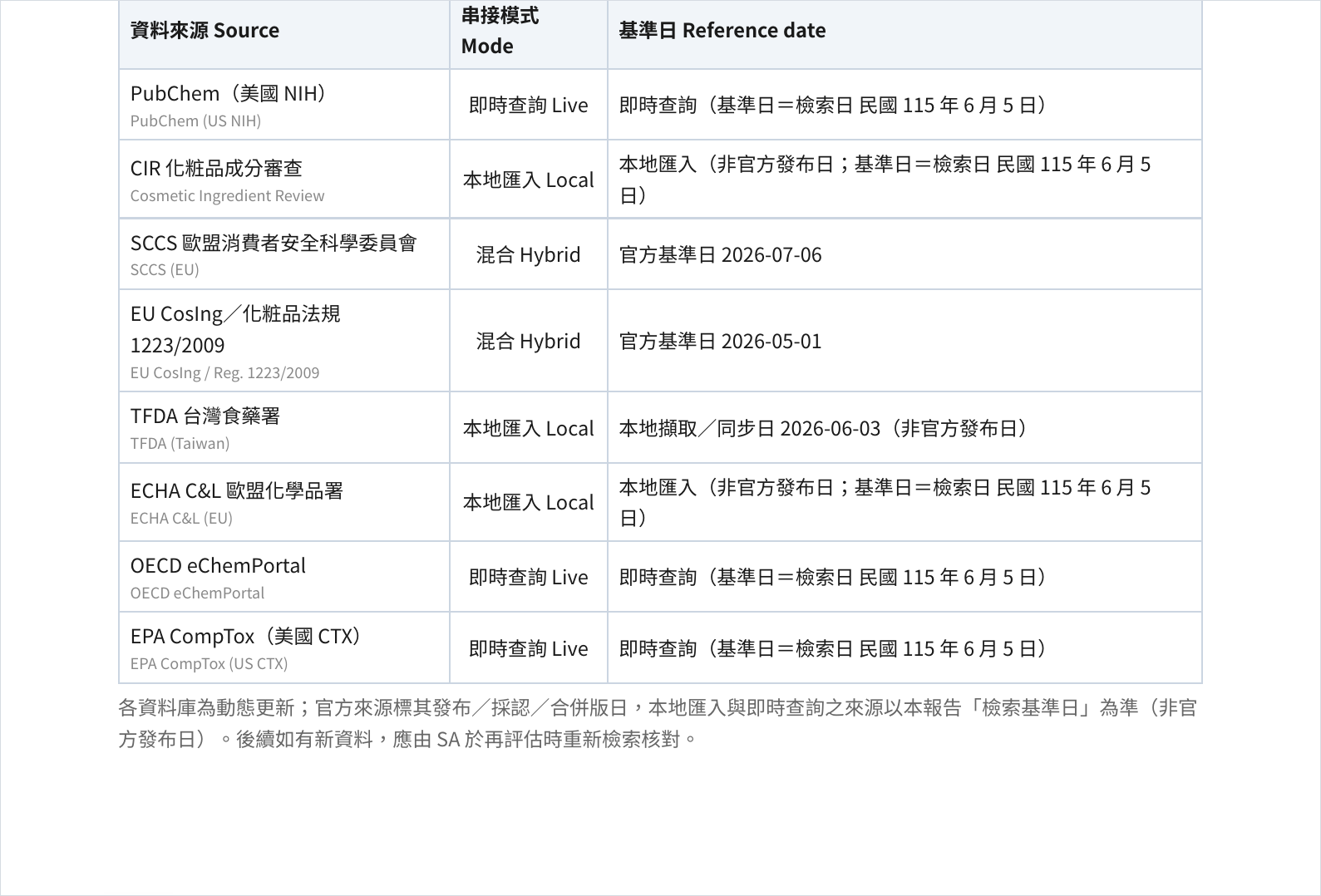
These 8 databases each have a role; none is dispensable:
- PubChem (US NIH): the world's largest chemical substance database, providing physicochemical properties, GHS hazard classifications and toxicological endpoints. It is the backbone of every query — almost every ingredient has a basic record here.
- ECHA C&L Inventory (EU): the EU's Classification & Labelling Inventory, covering GHS classifications for over 130,000 substances — the authoritative basis for whether an ingredient is officially classified as an irritant / sensitiser / carcinogen.
- OECD eChemPortal: the OECD's international chemicals portal, integrating toxicology study reports produced under GLP across multiple countries — an important source of NOAEL, LD50 and other experimental data.
- Taiwan TFDA: the Taiwan FDA's lists of prohibited, restricted, preservative, colorant and UV-filter cosmetic ingredients (official OpenData). This is the lifeline of local compliance — an ingredient safe internationally may not be legal at this use and concentration in Taiwan.
- CIR (US Cosmetic Ingredient Review): the US body dedicated to assessing the safety of cosmetic ingredients and issuing conclusion reports. It is the cosmetics-specific gold source — many ingredients' NOAELs and safety conclusions are cited directly from CIR.
- EU CosIng: the EU cosmetic ingredients database, derived from Annex II–VI of Regulation 1223/2009 (prohibited, restricted, permitted colorants / preservatives / UV filters) — the basis for an ingredient's regulatory status in the EU.
- EU SCCS: the Scientific Committee on Consumer Safety, publishing scientific Opinions on cosmetic ingredients containing detailed NOAEL/MoS derivations — the benchmark for safety assessment methodology.
- EPA CompTox (US CTX): the hazard API of the US EPA's Center for Computational Toxicology and Exposure, providing authoritative hazard classifications (skin/eye irritation, sensitisation, genotoxicity, carcinogenicity) — the key new member that fills out the endpoint matrix.
Why insist on 8? Because no single database is complete. CIR covers common US cosmetic ingredients; SCCS leans toward recently reviewed EU substances; TFDA governs Taiwan-local regulation; EPA CompTox excels at high-throughput hazard screening. Stacked together they maximise the coverage of "what can be found," and when multiple sources point to the same conclusion they corroborate one another, raising confidence.
More important is the authority precedence. When different sources hold data for the same endpoint, the report prefers the more authoritative, more fully structured source. For an ingredient's genotoxicity, say, if EPA CompTox has an explicit authoritative classification, the report defers to EPA rather than relying solely on PubChem's GHS labelling — because the former is a structured result with species, year and verdict, while the latter is just a hazard code.
The endpoint matrix: 10 questions, each answered "is there data?"
A NOAEL alone is not enough. An ingredient's safety must be examined across multiple "toxicological endpoints" — does it irritate skin? harm eyes? cause sensitisation, mutation, cancer? These are different questions requiring different data. The report uses a "toxicological endpoint coverage matrix" mapping each ingredient against 10 endpoints, honestly marking whether each cell "has a data source."
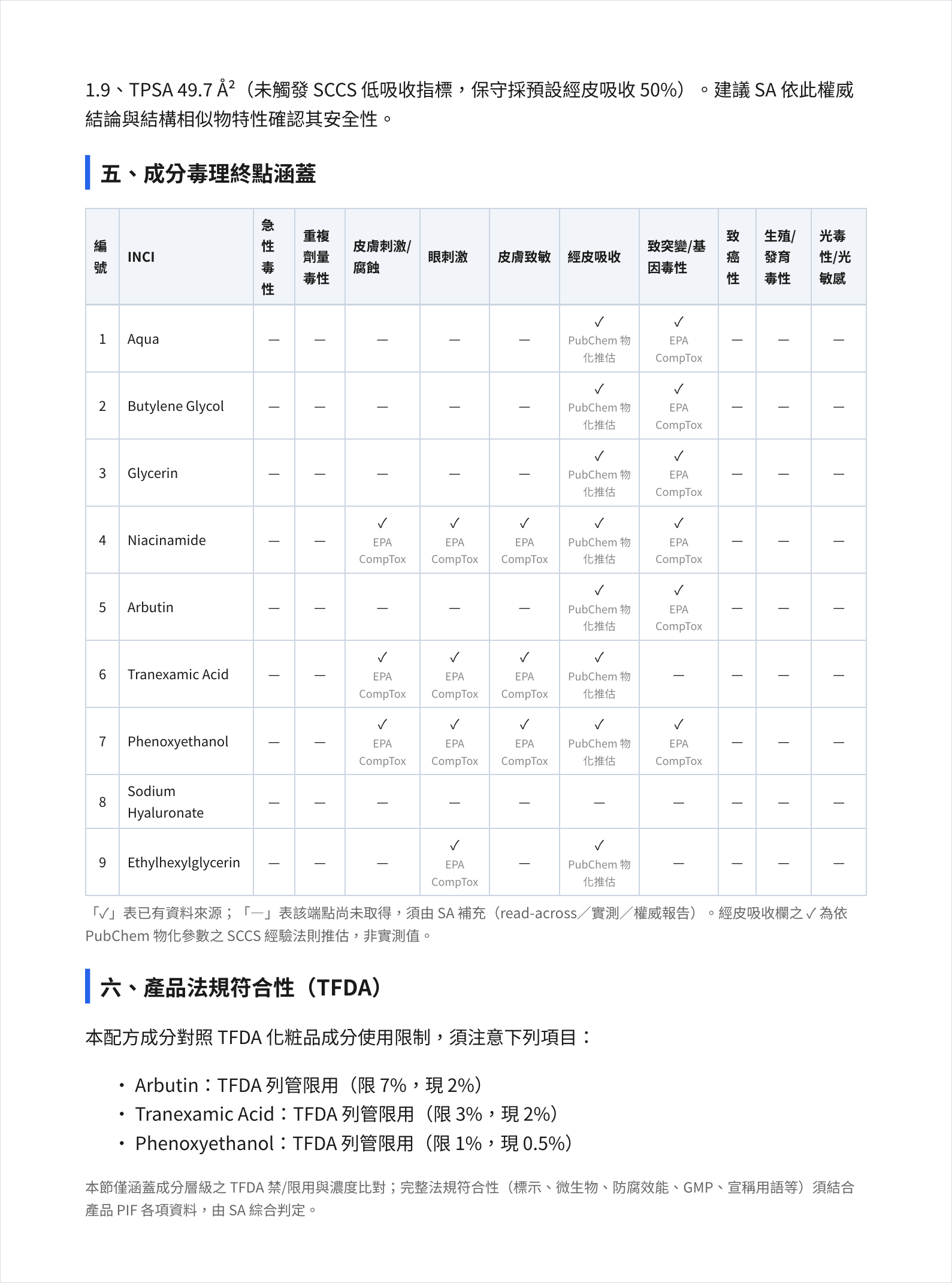
The 10 endpoints are: acute toxicity, repeated-dose toxicity, skin irritation/corrosion, eye irritation, skin sensitisation, dermal absorption, genotoxicity/mutagenicity, carcinogenicity, reproductive/developmental toxicity, and phototoxicity/photosensitisation — precisely the facets that international safety assessment methodology requires to be addressed one by one.
The value of this matrix is that it leaves data gaps nowhere to hide. Which ingredient lacks data for which endpoint, requiring the SA to reinforce it via read-across or TTC, is laid bare. It does not manufacture an illusion of "all safe" with a sea of green ticks — not found is not found, and that honesty is exactly what a professional reviewer wants.
This is also where adding EPA CompTox as the 8th database earns its place. Before it joined, endpoints like skin irritation, eye irritation, skin sensitisation and genotoxicity could often only be barely covered by PubChem's GHS hazard codes — frequently a row of "—." EPA CompTox's CTX hazard API provides authoritative hazard summaries with classification, species and year, filling these cells from blank into evidenced "✓" in one stroke — and tagged clearly "source: EPA CompTox." The matrix turns green because the data is really there, not because an algorithm wanted it to be.
The last mile of credibility: reference dates, source tags, tamper-evidence
By now the report has made "is it safe" clear. But a document to be filed with the authorities and used as evidence in a dispute must answer two more questions: when is this data from? and has the report been altered after the fact?
First, reference dates. Looking back at the data-source table, each source is tagged with an "integration mode" and a "reference date":
- Live: e.g. PubChem, OECD, EPA CompTox — queried in real time at report generation; the reference date is the retrieval date.
- Hybrid: e.g. SCCS, CosIng — based on the official publication/adoption date (e.g. the consolidated date of the EU Cosmetics Regulation).
- Local: e.g. TFDA, CIR, ECHA — based on the local fetch/sync date, honestly marked "not the official publication date."
Why so meticulous? Because toxicology data gets updated. An ingredient safe today may not remain on the permitted list after a new study appears next year. Stating the reference date stamps the report's "shelf life" — a reviewer sees at a glance which point of scientific consensus the conclusion rests on. Making this explicit is professionalism; glossing over it is risk.
Second, tamper-evidence. Every page of the report carries a QR code, and the header states the report_id and doc_hash (the SHA-256 hash of the content). Anyone can scan the QR, or upload the report at pif.baiyuan.io/verify, and the system compares the per-page hashes to judge whether it matches the original. If the printed content disagrees with the online verification, pages may have been swapped or numbers changed. For a document that may carry legal liability, this ability to "prove its own integrity" is not a bonus — it is a necessity.
What AI can and cannot do
We must face one thing honestly: much of the above — 8-database cross-referencing, SED/MoS calculation, endpoint inventory, report generation — is done automatically by AI. So what exactly has AI replaced, and what can it not replace?
AI replaces the grunt work of data hauling and preliminary calculation. Previously, a safety assessor would manually query 8 databases for a formula, transcribe NOAELs, apply formulas to compute SED/MoS, and compile tables — often days per report. AI compresses this to minutes, without mis-transcribing, without missing a lookup, with every number auto-attributed. That is a genuine productivity leap.
But what AI cannot replace is the final professional judgement. When there is a data gap — whether to use read-across, which analogue, which TTC tier — that is the responsibility and signature of the SA (Safety Assessor). Everything AI produces is essentially a high-quality draft; it shifts the SA from "data drudge" to "professional adjudicator," spending time where human expertise is truly needed rather than on transcription.
So the correct framing is: AI is not here to replace safety assessors, but to give them an unprecedented magnifying glass and calculator. By honestly exposing the source of every number and flagging every gap, the report gives the SA's professional judgement a reliable footing. A good AI safety-assessment tool is measured not by "how well it talks about safety," but by "how honestly it presents the evidence and the uncertainty."
Three common misconceptions about safety assessment reports
Having dissected the report, let us clear up three misconceptions common in the industry that carry real risk.
Misconception 1: "Natural ingredients are automatically safe, no assessment needed." One of the most dangerous myths. Natural and safe are two different things — certain fragrance components in essential oils are known allergens; some botanical extracts are irritating at high concentration. A safety assessment looks at dose and exposure, not an ingredient's "pedigree." However natural, above the safe concentration it can still cause problems — which is why the report computes MoS per ingredient and per concentration, rather than labelling things "natural / synthetic."
Misconception 2: "Others have used this ingredient for years without incident, so it's safe." "No incident" is not "assessed." A safety assessment requires prior, methodical evidence, not after-the-fact luck. Besides, "their product" and "yours" may differ entirely in dosage form, concentration, application site and contact time — others' rinse-off at 1% being fine does not mean your leave-on at 5% is. The report's value is to quantify these differences into comparable numbers.
Misconception 3: "With an AI report, you no longer need an SA signature." Quite the opposite. AI produces an evidence-complete, fully calculated draft, but the statutory safety-assessment responsibility still rests with a qualified SA. By laying out all 8 sources, the SED/MoS and the endpoint gaps, the report exists precisely so the SA can sign "with grounds" — not to replace the signature. Submitting an AI draft as the final version mistakes the tool's convenience for a release from responsibility — untenable in compliance terms.
Closing: let every "safe" stand on evidence
We have read from a report's cover all the way to its last page. You will find the whole design philosophy of a safety assessment report comes down to one sentence: every conclusion must trace back to evidence; every number must say where it came from.
The ingredient table opens each ingredient's safety ledger; SED/MoS converts exposure into comparable margins; 8 international databases provide traceable authoritative sources; the endpoint matrix leaves gaps nowhere to hide; reference dates and tamper-evidence stamp the report's credibility. This is not to make the report look impressive, but because — cosmetic safety should never rest on "trust me," but on "you can verify."
From July 1, 2026, every cosmetic in Taiwan must establish a complete PIF, and the safety assessment is its most technically demanding part. As this shifts from "a craft of a few experts" to "a daily reality every brand must face," a tool that integrates 8 major databases in real time, attributes every number, and leaves the final judgement to a professional SA is no longer a nice-to-have but the infrastructure of an industry's upgrade.
- Try PIF AI toxicology analysis — pif.baiyuan.io/toxicology
- Explore Baiyuan's full product line — baiyuan.io
- Book a consultation — Contact us
This article was written by Baiyuan Technology Co., Ltd., published June 2026. The report screenshots are taken from an anonymised demo formula for illustration only and do not reference any specific product.
Regulatory note: The PIF AI toxicology analysis described here is an aid for cosmetic safety assessment, not legal advice or a statutory safety-assessment service. All AI-generated content is draft in nature and does not replace the professional assessment and signature of a qualified SA. The applicability of values such as SED/MoS and NOAEL must be judged independently by an SA qualified under Taiwan's PIF regulations. Database contents change over time; actual query results are governed by the reference dates stated in the report.