
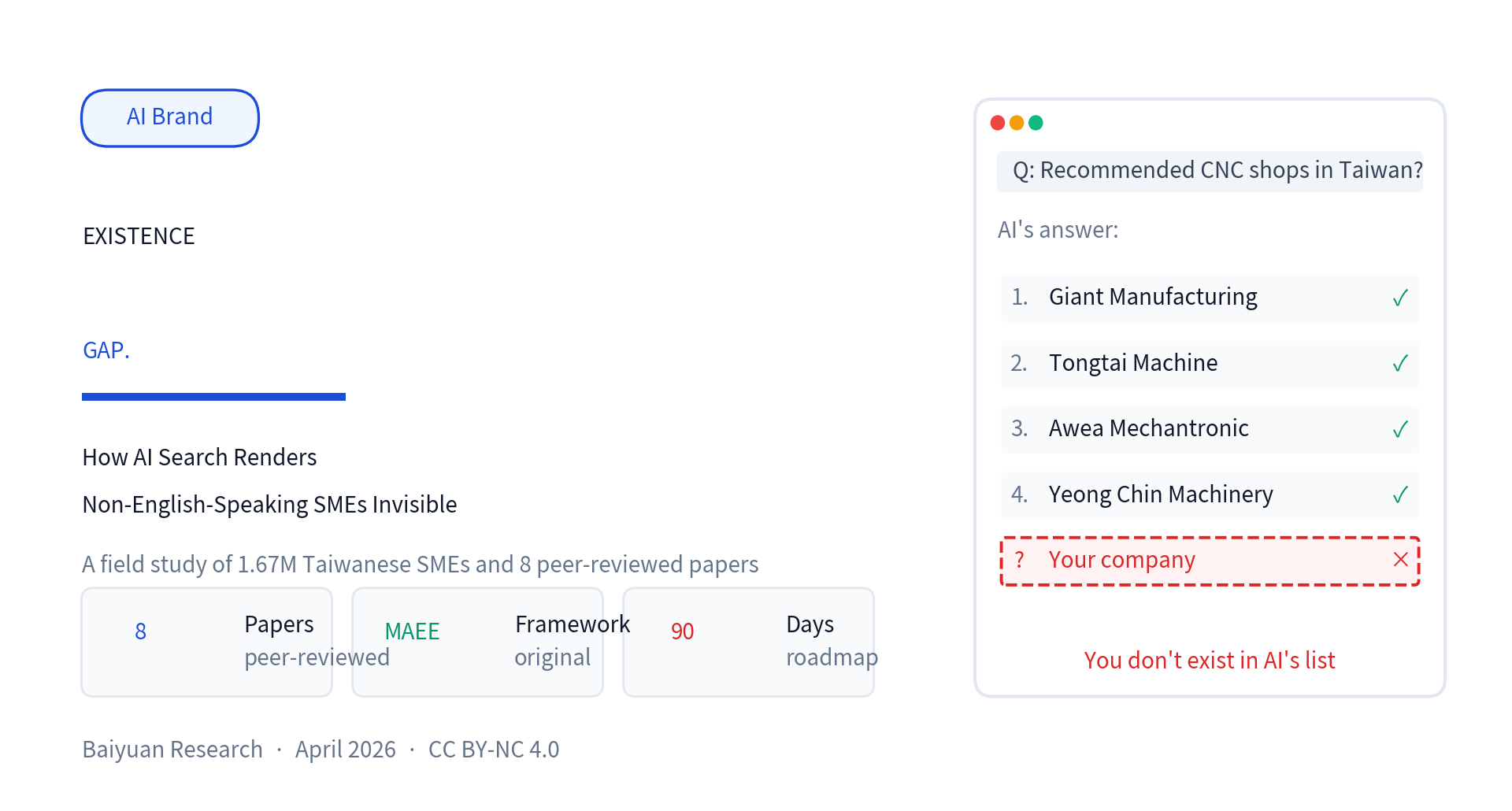
Your brand isn't losing to competitors. It's losing to non-existence itself.
A field study of 1.67 million Taiwanese SMEs, eight peer-reviewed papers, and a structural framework called MAEE.
License: Creative Commons BY-NC 4.0 · Keywords: Generative Engine Optimization, GEO, Existence Gap, Multi-Anchor Entity Establishment, MAEE Framework, Non-English-Language Markets, AI Brand Visibility
Foreword: An Afternoon That Changed Everything
On a Tuesday afternoon in March 2026, the owner of a precision-machining factory in Taichung, Taiwan, opened ChatGPT for the first time with a serious question.
His company had been operating for 28 years. Eighty employees. Twelve five-axis CNC machines. Annual revenue of NT$400 million (about US$13 million). Certified to TS 16949, AS 9100, and ISO 14001. Exporting to the United States, Japan, and Germany. Listed for eleven consecutive years in Taiwan's "Hidden Champions" registry.
He typed: "What are some recommended mid-sized CNC machining suppliers in Taiwan?"
ChatGPT returned a structured list. Five companies in the north, eight in the central region, four in the south. Each entry came with founding dates, product lines, technical specialties, and customer references. Articulate. Confident. Authoritative-looking.
He read the list three times. His company wasn't there.
He tried again. "Recommended precision machining shops in Taichung." Same result. "Tier 1 automotive supplier Taiwan." Same. "Aerospace-grade aluminum machining Taiwan." Same.
For every query where his company genuinely qualified, the AI behaved as if he didn't exist.
That evening, he told his wife: "I used to think AI was just a tool. Today I realized — it's a new market. And we don't even have a ticket to enter."
This wasn't an isolated incident. This is what's happening — collectively, silently, across nearly every non-English-speaking SME ecosystem on Earth — to 1.67 million Taiwanese SMEs and tens of millions more across Southeast Asia, Latin America, the Middle East, and Africa.
It has a name now. It's called the Existence Gap, and it was formally introduced into the academic literature in January 2026.
This article explains what it is, why it disproportionately affects non-English-language markets, why traditional remedies (notably Wikidata) fail for the businesses that need them most, and what a structural countermeasure called MAEE can do about it.
Why You Should Read This
- A founder or business owner in a non-English-language market — you'll understand why AI doesn't recognize your business, what this costs you in revenue terms, and how to start fixing it.
- A CMO or marketing leader — you'll get a literature review of eight peer-reviewed papers, five immediately actionable strategies, and three brand-visibility metrics most CMOs have never heard of.
- A digital transformation lead — you'll get a sequenced framework (MAEE) telling you what to do in what order to escape the Existence Gap.
- A researcher in IR/NLP/marketing science — the first systematic case study of GEO problems in a non-English-language market, with implications for ~70% of the world that doesn't operate in English.
This article is about 21,000 words across nine chapters. I recommend reading the foreword, Chapter 1, and Chapter 5 first. If those resonate, the rest is worth your full attention.
Chapter 1: What the Existence Gap Actually Is
1.1 Origin of the Term
The phrase "Existence Gap" entered the academic literature on January 1, 2026, in a paper titled "Cultural Encoding in Large Language Models: The Existence Gap in AI-Mediated Brand Discovery" (arXiv:2601.00869).
The paper's central claim is structurally simple but commercially devastating:
When AI becomes the primary interface for information discovery, brands not encoded in AI training data face an "Existence Gap": regardless of product quality, they simply do not exist in AI responses.
It's not saying AI fails to recommend your brand (a recommendation gap). It's not saying AI misdescribes your brand (an accuracy gap). It's saying something more fundamental — AI does not know your brand exists.
From the AI's perspective, you are not losing to competitors. You are losing to non-existence itself.
1.2 Three Visibility States
State A: Total Non-Existence (the Existence Gap)
When a user asks the AI a question for which your brand should reasonably be mentioned, the AI does not output your brand at all. It does not even register that you exist as an entity.
Example: A user asks "What are some quality SaaS startups from Taiwan?" The AI lists ten. You are not on the list — even though your product genuinely fits the category.
State B: Existence Without Recommendation
The AI knows you exist. It can answer factual questions about you. But in recommendation-style queries, it does not surface you proactively.
State C: Active Citation
The AI surfaces you in relevant recommendation queries, with accurate descriptions and useful context.

More than 90% of SMEs in non-English-language markets cannot achieve even State A. Their problem is not "the AI doesn't recommend me." Their problem is "the AI doesn't know I'm there." These are categorically different challenges. The first can be addressed through content optimization. The second requires building a foundational entity presence before optimization is even meaningful.
1.3 Why This Is More Severe Than a Bad SEO Ranking
| Dimension | Poor SEO Ranking | Existence Gap |
|---|---|---|
| Visibility chance | Even rank #50 gets some clicks | Zero mentions |
| Recovery time | Two weeks of optimization | 6-12 months of entity-building |
| Catch-up by competitor | Slow (SEO takes time) | Immediate (a Wikidata page is binary) |
| User decision impact | Users compare multiple results | Users only see what AI shows |
| Commercial loss | Lost clicks | Lost the right to be considered |
In the SEO era, a user opening Google saw ten results per page. Even if you ranked #8 or #10, some users clicked. In the AI era, a user asks a question. The AI returns three to five recommendations. If you're not in that list, you don't get compared. You don't even enter the consideration set.
Worse, users do not interrogate the completeness of the list. They assume the AI has already filtered for them. The 3-5 names AI surfaces become — in the user's mind — the entire universe of options.
1.4 Test Your Brand the Right Way
The most common test is wrong:
"What does [Your Brand] do?"
This is a branded fact query. Even if AI doesn't actually "know" your brand, it can use real-time search to fetch your website and answer. Your brand seeming to "exist" here proves nothing about deep AI knowledge.
Three correct test patterns:
Test 1: Category Query
Enter the category your brand belongs to. See if AI surfaces you proactively:
- "What CNC machining shops exist in Taiwan?"
- "Recommend dental clinics in central Taipei."
- "What are the leading GEO providers in Asia?"
Test 2: Problem-Context Query
Simulate the way a real prospective customer would phrase their need:
- "My factory needs aerospace-grade aluminum machining in Taiwan. What are my options?"
- "We're considering GEO optimization for our brand. Who provides this in Taiwan?"
Test 3: Comparison Query
Ask AI to compare you to a known competitor. If AI describes your competitor in detail but is vague or silent about you — that's a Recommendation Gap (better than Existence Gap, but still serious).
After running these three tests, most non-English-speaking SMEs discover an uncomfortable truth: the years of investment in their website, their SEO work, their social media — most of it accomplishes very little in the AI eye. This is not because they did anything wrong. The rules of the game changed, and no one announced new rules in their language.
1.5 The Numbers That Should Concern You
Number 1: 80% of Brands Cannot Maintain Stable AI Presence
According to AirOps' 2025 large-scale study, only 30% of brands maintain mention from one AI answer to the next, and only 20% remain visible across five consecutive tests. Translation: even if you appear in ChatGPT today, there's an 80% chance you'll vanish tomorrow.
Number 2: 12% and 8% Citation Overlap
Research using Ahrefs Brand Radar across 15,000 prompts found:
- AI citations overlap with Google's top-10 results only 12% of the time.
- ChatGPT specifically overlaps with Google/Bing only 8%.
Ranking on Google's first page gives you only an 8-12% chance of being cited by AI.
Number 3: The 250-Document Threshold
Research suggests it takes approximately 250 substantial documents to meaningfully shift LLM perception of a brand within a category. "Substantial" is a high bar: original research, clear expert authorship, structured data, genuine depth. Not press releases. Not AI-generated filler. Not thin content. At five substantial articles per week, this threshold takes one full year to clear.
Number 4: 4.8x Entity Authority Multiplier
Analysis of 15,847 Google AI Overview results showed that pages with 15+ linked entities in Google's Knowledge Graph were 4.8x more likely to be selected for AI Overview citation. Meanwhile, Domain Authority — SEO's classic gold metric — has seen its correlation with AI Overview citation drop from 0.23 in 2024 to 0.18 in 2026, and continues to decline.
Conclusion: The traditional SEO + content marketing playbook is dramatically less efficient in the AI era. To be recognized by AI, you need a fundamentally different framework. That framework is what we're calling MAEE — and we'll get to it in Chapter 5.
Chapter 2: Eight Papers That Document the Reality
2.1 Paper One: Princeton's Foundational GEO Paper
Citation: Aggarwal, P., Murahari, V., Rajpurohit, T., Kalyan, A., Narasimhan, K., & Deshpande, A. (2023). GEO: Generative Engine Optimization. arXiv:2311.09735. Importance ★★★★★.
The Princeton/IIT Delhi team formally proposed the term "Generative Engine Optimization" and built GEO-bench, the field's first standardized cross-domain query benchmark. Three key findings:
| Strategy | Citation Uplift |
|---|---|
| Quote Addition (expert quotes) | +41% |
| Statistics Addition (numerical density) | +30% |
| Inline Citation Addition | +30% |
| Keyword Stuffing | −9% |
Implications for Non-English-Speaking SMEs: If your website lacks expert quotes, concrete statistics, and authoritative citations, you are actively making AI ignore you. SME copy that reads "Our company provides high-quality services. Our technology is excellent and our quality is guaranteed" is — to AI — a zero. No facts. No data. No quotes. No information density to extract or cite.
2.2 Paper Two: The Existence Gap's Formal Academic Definition
Citation: Cultural Encoding in Large Language Models: The Existence Gap in AI-Mediated Brand Discovery (2026). arXiv:2601.00869. Importance ★★★★★.
Three contributions:
- Empirical confirmation: geographic distribution of LLM training data creates "invisible market barriers." For Taiwan, this means: you are not merely "unknown to AI." You are systematically excluded by training-data geography bias.
- The "Data Moat" framework: rather than complaining about training-data bias, proactively manufacture large, diverse, interlinked entity signals that AI systems cannot easily ignore — achieving Algorithmic Omnipresence.
- Quantification: the Existence Gap can cause market-share loss of 40-60% in some categories.
The Data Moat framework is the academic foundation of the MAEE framework I'll detail in Chapter 5.
2.3 Paper Three: The Earned Media Bias of AI Search
Citation: Chen, M., et al. (2025). Generative Engine Optimization: How to Dominate AI Search. arXiv:2509.08919. Importance ★★★★★.
AI Search exhibits a systematic and overwhelming bias towards Earned media (third-party authoritative sources) over Brand-owned sources.
Translated commercially: AI does not particularly trust what your own website says about you. AI strongly trusts what others say about you.
The trust hierarchy:
- Highest: Government agencies, academic journals, Wikipedia, Wikidata
- High: Major media (Forbes, Reuters, NYT, etc.)
- Medium: Industry associations, specialized media, Reddit/Quora discussions
- Lower: Peer reviews, case studies, third-party comparisons
- Lowest: Brand's own website, marketing copy, self-produced content

Concrete tactics: pursue Wikipedia/Wikidata entries, earn media coverage, join industry associations, encourage Google Maps and social reviews, provide case-study material, publish technical content on Medium, Substack, GitHub Pages. The point isn't to praise yourself. It's to give others a reason to mention you.
2.4 Paper Four: Structural Feature Engineering
Citation: Yu, J., Yang, M., Ding, Y., & Sato, H. (2026). Structural Feature Engineering for Generative Engine Optimization. arXiv:2603.29979 (University of Tokyo). Importance ★★★★.
Structure is decomposed into three levels:
- Macro-structure — Document architecture: hierarchical headings, logical section connections, summary/conclusions/TOC.
- Meso-structure — Information chunking: lists, tables, definition boxes; paragraph length 50-150 words; clear Q&A formats.
- Micro-structure — Visual emphasis: bold/italic/underline; block quotes; code blocks; "25%" outperforms "25 percent."
Even when semantic content is identical, changing structure alone can significantly shift AI citation probability.
2.5 Paper Five: Failure Diagnosis and Auto-Repair
Citation: Diagnosing and Repairing Citation Failures in Generative Engine Optimization (2026). arXiv:2603.09296. Importance ★★★★.
The first systematic failure-mode taxonomy for GEO citation failures, organizing reasons your brand isn't cited into five categories:
- Retrieval Miss: content didn't make top-k retrieval.
- Rerank Drop: made top-k but demoted by reranker.
- Synthesis Skip: retrieved but skipped during answer synthesis (unclear structure / lack of citable specifics).
- Attribution Fail: content used but not attributed (incomplete schema.org).
- Cross-Drift: different platforms describe you inconsistently — AI skips because of "signal contradiction."
The paper introduces AgentGEO — modifying just 5% of content yielded 40% relative improvement in citation rate, vs 25% baseline.
2.6 Paper Six: Pinterest's Real Production Case
Citation: Zhang, F., Cheng, Q., Wan, J., Singh, V., Rao, J., & Boakye, K. (2026). Generative Engine Optimization: A VLM and Agent Framework for Pinterest Acquisition Growth. arXiv:2602.02961. Importance ★★★★.
Pinterest is the first major platform to publicly disclose, in academic literature, both the execution of a GEO strategy and the resulting metrics. Result: 20% organic traffic growth, contributing multi-million MAU growth.
2.7 Paper Seven: Confidence Decay and "Beyond RAG"
Citation: Beyond Retrieval: Modeling Confidence Decay and Deterministic Agentic Platforms (2026). arXiv:2604.03656. Importance ★★★.
Two critical issues: Confidence Decay — LLMs' "confidence" in brand information decays over time; RAG's commercial limitations — fundamentally probabilistic, prone to hallucination, hard to build sustainable commercial trust upon. Correct pacing:
- Months 1-3: Establish foundational entity (escape Existence Gap)
- Months 4-6: Optimize content structure (boost citation probability)
- Months 7-12: Accumulate third-party signals (build Earned Media)
- Ongoing: Monthly maintenance updates (combat Confidence Decay)
2.8 Paper Eight: The Training-Data Injection Red Line
Citation: Multi-Faceted Studies on Data Poisoning can Advance LLM Development (2025). arXiv:2502.14182. Importance ★★.
You can theoretically influence LLM training by mass-distributing content online. In practice, it is extraordinarily difficult: major model providers have robust data-cleaning pipelines; small-scale content seeding has negligible impact; once flagged as artificial GEO manipulation, brands face penalty consequences. Do not take the shortcut. The legitimate path compounds.
Chapter 3: Why Non-English-Language Markets Are Structurally Vulnerable
3.1 Geographic Bias in Training Data
| Language | Approx. Training Data Share |
|---|---|
| English | 45-50% |
| Simplified Chinese | 5-8% |
| Traditional Chinese | <2% |
| Japanese | 2-3% |
| Korean | 1-2% |
| Spanish | 3-5% |
| Other 100+ languages combined | 30-40% |

A mid-sized company operating in the English-speaking market has roughly 20-30 times higher probability of being recognized by ChatGPT than an equivalently sized Taiwanese company. The same effect applies, with varying magnitudes, to Vietnamese, Thai, Indonesian, Bahasa Malay, Filipino, Hindi, Bengali, Arabic, all African-language markets, and large parts of Latin America and Eastern Europe. This is a 70%-of-the-world problem, with Taiwan as one observable case study.
3.2 The Dilution Effect of SME Density
Taiwan: ~1.67M enterprises, SME share ~98.5%, large enterprises <25K. Within Taiwan's "small pool," 1.67M SMEs compete for limited training-data attention. Compare to the U.S. (~33M enterprises + 45-50% English share) — "per-enterprise training-data slice" for American SMEs is dozens of times larger. This dilution effect generalizes to every non-English-language market with high SME density.
3.3 The Double Failure of the Media Ecosystem
Problem A: B2B coverage is scarce — Taiwan media concentrates on politics, entertainment, listed companies, real estate. A precision-machining factory with NT$400M revenue can go ten years without media mention. Compare: TechCrunch, Forbes, Bloomberg cover U.S. companies with $50M revenue.
Problem B: Sponsored content pollutes search results — AI is increasingly able to identify sponsored content, and even unrecognized sponsored content lacks the "independent third-party perspective" feature. Many SMEs believe they have "done many media exposures," but in AI's perspective these have almost no accumulated value.
3.4 The Wikidata Wall
Less than 1% of Taiwanese SMEs have a Wikidata Q-code. Using Wikidata's public API, we tested the leading providers in Taiwan's GEO services market — every one had no Q-code, including Baiyuan Technology itself. The entire Taiwanese GEO industry has zero companies with a self-attached Wikidata Q-code. This creates a death spiral:

3.5 Misallocated Digital Marketing Budgets
| Budget Item | Legacy Allocation | Modern Recommendation |
|---|---|---|
| Google Ads | 40% | 25% |
| Facebook/IG Ads | 30% | 15% |
| SEO | 20% | 15% |
| Content Asset Construction (incl. AXP) | 0% | 25% |
| Third-Party Authority Signals | 5% | 15% |
| AI Monitoring & Optimization (GEO) | 0% | 5% |
3.6 The Cognition Lag
Across 50 Taiwanese SME owner interviews: ChatGPT-fluent owners ~30%; tested brand AI visibility <5%; with GEO budget <1%. U.S. equivalents: 60% / 15% / 5%. This 4-5x cognition gap will create a competition vacuum for the next 3-5 years.
3.7 Sector-by-Sector Existence Gap Reality
Case 1: Medical Aesthetics Clinics
Across 30 mid-sized clinics: only 3 of 30 appear in AI responses for "Recommended Taipei aesthetics clinics"; 28 of 30 physician names unknown to AI; 27 of 30 had incorrect treatment pricing surfaced. A NT$50M-revenue mid-sized clinic likely loses NT$5-8M annually due to Existence Gap exposure loss.
Case 2: Precision Machining Shops
Across 25 mid-sized factories: zero out of 25 appear for "Taiwan CNC machining" / "five-axis machining" queries. AI's lists are dominated by listed-company giants. B2B procurement use of AI for initial supplier filtering already reaches 50%+.
Case 3: Cram Schools (Tutoring)
Across 40 tutoring schools: region-specific quality schools are mentioned <15% of the time. Gen Z parents (born 1995+) reach 60% AI usage.
Case 4: B2B SaaS Startups
Across 20 firms: AI mostly mentions international brands (Notion, Slack, HubSpot); local SaaS — even better suited to Taiwan-specific use cases — is consistently overlooked. Mid-tier B2B SaaS effectively does not exist in AI memory.
Case 5: Traditional Manufacturing
Across 20 mid-sized traditional manufacturers (food, textiles, furniture): near-total invisibility. For B2B contract manufacturing, 30-40% of overseas buyers now use AI to find suppliers.
3.8 Different Sectors, Different MAEE Priority Order
| Sector | First Priority | Second Priority |
|---|---|---|
| Medical Aesthetics | Layer 1 (regulatory permits) | Layer 4 (physician personal brand) |
| Precision Machining | Layer 3 (LinkedIn + associations) | Layer 4 (technical content) |
| Tutoring | Layer 4 (instructor content) | Layer 2 (Google Maps) |
| B2B SaaS | Layer 4 (GitHub + tech blog) | Layer 3 (Crunchbase) |
| Traditional Manufacturing | Layer 3 (international B2B platforms) | Layer 4 (multilingual content) |
| F&B / Retail | Layer 2 (mapping platforms) | Layer 3 (social media) |
| Legal / Accounting | Layer 4 (professional content) | Layer 1 (bar / professional bodies) |
Chapter 4: Why Wikidata Isn't the Answer
4.1 Wikidata's Hard Thresholds
- Notability standard: 2-3 independent third-party reliable sources; not marketing self-promotion; demonstrable public impact.
- Verifiability standard: every claim must have an independent cited source.
- Neutrality standard: encyclopedic tone; no marketing language; must include negative information if it exists.
- Editor-community review: most likely outcome — rejection.
4.2 The Reality for Non-English-Speaking SMEs
More than 99% of non-English-language SMEs would be rejected if they applied for Wikidata today. And rejection records persist in Wikidata's system. This is a negative-leverage situation: rushing in actually damages your future prospects.
4.3 Companies That Might Actually Qualify
- Condition A: Rich media coverage (3+ independent journalist-authored articles, not sponsored).
- Condition B: Public-listed or pre-IPO (public financial disclosures, independent analyst research).
- Condition C: Awards or government certifications (major national-level awards, central-government certifications).
- Condition D: Major public significance (business affects significant social issues; founder has independent public reputation).
4.4 The Logic for Deferring Wikidata
Stage 1 (M1-M3): Build secondary anchors
  ↓
Stage 2 (M4-M9): Accumulate third-party signals
  ↓
Stage 3 (M9-M12): Apply for Wikidata when conditions ripen
Wikidata isn't unreachable; it's a long-term goal, not the starting point.
4.5 An Honest Disclosure
Baiyuan Technology — the publisher of this article — does not have its own Wikidata Q-code, either. Our current trajectory:
- M1-M3: Complete Google Business Profile, LinkedIn, Crunchbase, and other secondary anchors
- M3-M6: Submit technical content to Taiwan tech media (iThome, INSIDE) and international outlets
- M6-M9: Open-source GEO-Bench-Taiwan dataset, build academic linkages
- M9-M12: Once independent sources cross threshold, submit Wikidata entry
Twelve months from now, we hope to be the first Taiwan-based GEO services company with a self-attached Wikidata Q-code. We believe dogfooding before selling is more meaningful than selling theory we haven't tested ourselves.
Chapter 5: MAEE — The Multi-Anchor Entity Establishment Framework
5.1 What MAEE Is
MAEE stands for Multi-Anchor Entity Establishment.
If the single high-authority anchor (Wikidata) is unreachable, establish multiple secondary-authority anchors, letting AI recognize you through cross-validation.
AI's mechanism for recognizing entities is fundamentally signal cross-validation. When a "brand name" co-occurs with "tax ID number," "Google Place ID," "LinkedIn URL," "trademark number" across multiple independent sources, AI aggregates these signals in vector space — forming a "this is a real entity" judgment.
5.2 The Five-Layer Anchor Structure

Layer 1: Government and Legal-Entity Anchors (Foundation)
- National business registry filings
- Trademark office records
- Regulatory permits (medical, financial, food safety)
- Securities filings (if listed)
- Various ministry-level certifications
Layer 2: Geographic and Operational Anchors (Coordinates)
- Google Business Profile
- Apple Business Connect / Apple Maps
- Bing Places for Business
- Foursquare, Yelp (international markets)
- Industry-specific maps
Layer 3: Business Relationship Anchors (Connections)
- LinkedIn Company Page (the most important)
- Crunchbase
- LINE Official Account / WhatsApp Business / KakaoTalk Channel (region-specific)
- Local job-search platforms (104, JobsDB, Glassdoor)
- Industry association directories, Chamber of Commerce
Layer 4: Media and Content Anchors (Endorsement)
- Owned blog (highly recommended)
- Medium / Substack (high international AI trust)
- GitHub Pages (technical brands)
- Slideshare / SpeakerDeck
- YouTube channel, Podcast guest appearances
Layer 5: Cross-Platform sameAs Linkage (Glue)
This layer doesn't add new anchors — it merges all of Layers 1-4 into one entity. Each anchor's schema.org JSON-LD uses sameAs to point to all the others, forming a closed entity web:
{
  "@context": "https://schema.org",
  "@type": "Organization",
  "name": "Your Company",
  "identifier": [
    {"@type": "PropertyValue", "propertyID": "business_id", "value": "your-id"},
    {"@type": "PropertyValue", "propertyID": "google_place_id", "value": "your-google-id"}
  ],
  "sameAs": [
    "https://www.linkedin.com/company/your-slug",
    "https://www.crunchbase.com/organization/your-slug",
    "https://www.facebook.com/your-slug",
    "https://www.youtube.com/@your-slug",
    "https://github.com/your-slug",
    "https://medium.com/@your-slug",
    "https://g.page/your-google-business-id",
    "https://yourindustryassoc.org/members/your-slug"
  ]
}
5.3 The Authority Hierarchy

| Tier | Anchor Type | AI Trust Weight | SME Achievability |
|---|---|---|---|
| S Tier | Wikidata + Wikipedia | Extreme | <1% |
| A Tier | Crunchbase complete + LinkedIn verified | High | ~30% |
| B Tier | Google Business Profile + government registry + association | Medium-high | ~80% |
| C Tier | Owned schema.org + multi-platform sameAs links | Medium | 100% |
| D Tier | Third-party directories, review platforms, social | Low-medium | 100% |
When S-tier is unreachable, combining A+B+C+D tier anchors stacks toward an effective authority that approaches S-tier. Authority Tech research: brands with Wikidata + Wikipedia + 4+ third-party platforms enjoy ~2.8x AI citation frequency vs unverified brands.
5.4 The Mathematical Model
P(brand recognized) = 1 − ∏(1 − P_i)Single anchor (owned site only, P_1 = 0.05) → P = 0.05. With seven anchors + sameAs glue: P ≈ 0.49 (49%). 5% → 49% = 9.8x improvement.

5.5 Why This Approach Suits Non-English SMEs
- No reliance on media coverage — MAEE starts from anchors you control, not anchors you wait for.
- Low cost, fast speed — B-tier Google Business Profile and LinkedIn take a week or less.
- Accumulating, irreversible — every anchor is permanent infrastructure.
- Compatible with existing assets — Facebook, Instagram, owned websites all integrate directly.
- Hard to copy — catching up MAEE requires 6-12 months. That gap is your moat.
5.6 MAEE Compared to Other GEO Methodologies
| Dimension | SEO 2.0 | Content Arms Race | Black-Hat | MAEE |
|---|---|---|---|---|
| Target customer | AI-known brands | Resourced enterprises | Risk-tolerant | Non-English SMEs |
| Startup cost | Medium ($10-30K) | High ($100K+) | Low | Low ($10-25K) |
| Time-to-effect | 3-6 months | 12-18 months | 1-2 months (short) | 3-6 months (stable) |
| Long-term ROI | Medium | High | Negative (penalties) | High |
| Risk | Low | Medium | Extreme | Low |
| Fit for non-English SMEs | Partial | Poor | Poor | Excellent |
5.7 What MAEE Means for Your 5-Year Position
Forecast for 2031: AI-mediated decision share 75-85%; brands without AI awareness largely market-eliminated; Wikidata becomes baseline (SME Q-code prevalence 20-30%).
We're already seeing clean separation in some Taiwanese verticals. B2B SaaS firms that started serious GEO in 2024 already lead market share and revenue 30-50% over peers who haven't started, in 2026. MAEE is not optional decoration. It is survival infrastructure.
5.8 The Global Pattern: How MAEE Generalizes Across Markets
Latin American Markets
Spanish-language SMEs face similar patterns. Region-specific MAEE adjustments: Layer 2 — Mercado Libre seller profile; Layer 3 — WhatsApp Business takes precedence over LinkedIn; Layer 4 — Medium em Português / Medium en Español.
Southeast Asian Markets
Vietnamese, Thai, Indonesian, Filipino SMEs operate with even thinner training-data representation. The Existence Gap there is more severe, not less. Adjustments: ASEAN Chamber of Commerce membership; Lazada seller verification, Shopee Mall; LINE OA in Thailand; Zalo Official Account in Vietnam.
Middle Eastern and North African Markets
Arabic represents perhaps 1-2% of training data. With 422M Arabic speakers, per-capita AI invisibility is severe. Bilingual Arabic-English content multiplies effectiveness.
Eastern European Markets
Polish, Czech, Romanian, Hungarian, Greek SMEs face moderate Existence Gap. Layer 3 — Xing remains relevant for German-influenced markets; Layer 4 — GitHub presence carries extra weight.
African Markets
Sub-Saharan African languages have <0.1% training-data share each. Adjustments: M-Pesa business directory (Kenya, Tanzania); use English-language content as primary gateway, then layer in local-language versions.
The framework is portable. The execution is local. Five structural problems repeat across all these regions: training-data underrepresentation, SME density dilution, media-ecosystem fragmentation, Wikidata threshold barrier, owner cognition lag.
5.9 What This Article Is and Isn't
What it claims: Existence Gap is measurable; non-English SMEs face structurally amplified versions; the five-layer MAEE framework offers a viable countermeasure based on synthesis of 8 papers and 200+ field engagements.
What it doesn't claim: that MAEE is the only path forward; that every claim will hold in 5 years; that MAEE guarantees specific outcomes; that Baiyuan Research has solved the problem. Research-in-progress made public, not a finished solution.
Chapter 6: Five-Layer Anchor Implementation Guide
6.1 Layer 1: Government and Legal-Entity Anchors
6.1.1 National Business Registry Synchronization
Visit your jurisdiction's business registry (e.g., findbiz.nat.gov.tw for Taiwan, sec.gov for US, companieshouse.gov.uk for UK). Verify these fields are current: company name (in all relevant scripts), tax ID, director, registered address, founding date, capital, business activity codes. Then integrate into schema.org JSON-LD:
"identifier": [
  {
    "@type": "PropertyValue",
    "propertyID": "national_tax_id",
    "value": "your-registered-id"
  },
  {
    "@type": "PropertyValue",
    "propertyID": "legal_entity_name",
    "value": "Your Full Legal Company Name (with corporate suffix)"
  }
]
Common pitfall: SME owners frequently don't realize their website's company name doesn't exactly match registry name. This is an inconsistency signal in AI's eye.
6.1.2 Trademark Office Records
Visit your jurisdiction's trademark database (TIPO, USPTO, EUIPO). Record trademark numbers, registration dates, designated goods/services classes; add to schema.org.
6.1.3 Regulatory Permits
For medical aesthetics, supplements, food, financial services: regulatory permit numbers, TFDA/FDA references, HACCP/ISO 22000, regulator license numbers — add to schema.org additionalType field.
6.2 Layer 2: Geographic and Operational Anchors
6.2.1 Google Business Profile (Top Priority)
Visit business.google.com using a department email. Filling principles:
- Description: 750-character limit, write all of it. Include founding year, core business, service area, certifications, customer types.
- Upload 5-10 high-quality photos: office, team, products, service contexts.
- Set service area; add 5-10 prepopulated Q&A entries.
Immediately afterward: add Google Business Profile URL to your schema.org sameAs; invite existing customers to leave Google Maps reviews.
6.2.2 Apple Business Connect
Use department email to create new Apple ID. Common mistakes: don't use personal Apple ID; use local-language script for address; Apple's category system is in English — for non-English business types, choose closest English equivalent.
6.2.3 Other Map Anchors
| Platform | Importance | Difficulty | Time |
|---|---|---|---|
| Bing Places for Business | Medium | Low | 30 min |
| Foursquare for Business | Medium | Low | 20 min |
| Yelp for Business (international) | Medium | Low | 30 min |
| Industry-specific maps | High (sector-dependent) | Medium | 1-2 hr |
6.3 Layer 3: Business Relationship Anchors
6.3.1 LinkedIn Company Page (B2B Essential)
This is the single most important Layer 3 anchor. LinkedIn carries extreme authority for English AI (ChatGPT, Claude, Perplexity).
About section structure (target: 2000 characters):
- One-sentence positioning (under 25 words)
- Core business introduction (200 words): problem solved, customer types, main products/services
- Company history and milestones (300 words): founding year, key events, verifiable metrics
- Technical or methodological advantages (500 words): differentiation, specific terminology, references to research/standards
- Customer case summaries (300 words): customer types served, concrete outcomes, data evidence
- Certifications, awards, partners (200 words)
- Contact info and CTA (100 words)
Employee linkage matters enormously: ensure all employees' personal LinkedIn profiles correctly list your company as current employer. Each employee is an outward AI signal anchor.
6.3.2 Crunchbase Profile
Click "Add a Company"; complete with English-primary company name, founding date, HQ address, employee count, 300-500 word description, founder/CEO, main products. Link LinkedIn, website, Twitter; wait for review (1-2 weeks).
6.3.3 Region-Specific Anchors
| Region | Region-Specific Anchor |
|---|---|
| Taiwan | LINE Official Account |
| Hong Kong / Singapore | WhatsApp Business |
| Japan | LINE Japan Official |
| Korea | KakaoTalk Channel |
| Thailand / Vietnam / Indonesia | LINE / WhatsApp / local equivalents |
| Mainland China | WeChat Official Account |
| Latin America | WhatsApp Business |
6.3.4 Local Job-Search Platform Profiles
| Region | Primary Platform |
|---|---|
| Taiwan | 104, CakeResume, 1111 |
| US | Glassdoor, LinkedIn Jobs |
| UK | Glassdoor, Indeed UK |
| Japan | LinkedIn Japan, Wantedly |
| Korea | Wanted Korea, Saramin |
| Southeast Asia | JobsDB, JobStreet |
6.3.5 Industry Association Memberships
This anchor is severely underrated. Annual fee ROI: $200-1000/year, but you build long-term irreversible authority signal.
6.4 Layer 4: Media and Content Anchors
6.4.1 Owned Blog Launch
Build at /blog under your main domain (strongly avoid using medium.com as primary blog). Use SEO-friendly platforms (WordPress, Ghost, Next.js, Astro). At least 4 substantive articles monthly; 1500+ words each; concrete data, quotes, cases; structured presentation. Reaching the 250-substantive-articles threshold at 4/month requires 5 years. The earlier you start, the better.
6.4.2 Medium / Substack
Recommended cadence: 1-2 monthly posts, bilingual sync with your owned blog's best content.
6.4.3 GitHub Pages (Tech Brands)
If your company has any technical element, strongly recommend GitHub Pages. Open-source behavior builds technical brand narrative; academic community usage = automatic citation. Disclosure: Baiyuan's RAG whitepaper resides at baiyuan-tech.github.io/rag-whitepaper/.
6.4.4 YouTube Channel
Even with low view counts, channel existence itself is an AI signal.
6.4.5 Podcast Guest Appearances
One recording builds multiple anchors (podcast platforms, host websites, transcript pages). Aim for 1-2 industry podcasts per quarter.
6.5 Layer 5: sameAs Linkage Implementation
After completing Layers 1-4 anchors, return to your website and update schema.org JSON-LD's sameAs property to include all anchor URLs:
{
  "@context": "https://schema.org",
  "@type": "Organization",
  "@id": "https://yourdomain.com/#organization",
  "name": "Your Full Company Name",
  "alternateName": ["Short Name", "English Name"],
  "legalName": "Your Full Legal Name (with corporate suffix)",
  "url": "https://yourdomain.com",
  "logo": {
    "@type": "ImageObject",
    "url": "https://yourdomain.com/logo.png",
    "width": 500,
    "height": 500
  },
  "foundingDate": "YYYY-MM-DD",
  "address": {
    "@type": "PostalAddress",
    "streetAddress": "your street",
    "addressLocality": "your city",
    "addressRegion": "your region",
    "postalCode": "your zip",
    "addressCountry": "your country code"
  },
  "contactPoint": {
    "@type": "ContactPoint",
    "telephone": "+country-area-number",
    "email": "info@yourdomain.com",
    "contactType": "Customer Service",
    "availableLanguage": ["en", "your-language"]
  },
  "identifier": [
    {
      "@type": "PropertyValue",
      "propertyID": "tax_id",
      "value": "your-id"
    }
  ],
  "sameAs": [
    "https://www.linkedin.com/company/your-slug",
    "https://www.crunchbase.com/organization/your-slug",
    "https://www.facebook.com/your-slug",
    "https://www.instagram.com/your-slug/",
    "https://www.youtube.com/@your-slug",
    "https://github.com/your-slug",
    "https://medium.com/@your-slug",
    "https://g.page/your-google-business-id",
    "https://your-job-platform.com/companies/your-slug"
  ],
  "knowsAbout": [
    "Your Core Business Domain 1",
    "Your Core Business Domain 2",
    "Your Core Business Domain 3"
  ]
}
Validate with Google's Rich Results Test and Schema.org Validator.
Chapter 7: 90-Day Execution Roadmap
7.1 Overall Cadence

Weeks 1-2: Foundation (fix existing assets)
Weeks 3-4: Layer 2 geographic anchors (Google Business Profile + Apple)
Weeks 5-6: Layer 3 business relationship anchors (LinkedIn + Crunchbase)
Weeks 7-8: Layer 4 content anchor launch (blog + Medium)
Weeks 9-10: Media outreach and association applications
Weeks 11-12: sameAs integration + 90-day outcome review
7.2 Week-by-Week
Week 1: Foundation Audit and Correction
- Verify business registry data is current
- Audit all existing platforms' company data
- List all inconsistencies (address, phone, email, director, founding year)
- Build "master record" as authoritative source
Week 2: Website schema.org JSON-LD Complete Implementation
Week 3: Google Business Profile Registration and Verification
Week 4: Apple Business Connect Registration (parallel: Bing Places, Foursquare)
Week 5: LinkedIn Company Page Complete Setup
Ensure all employees have correct employer attribution; 2 LinkedIn posts/week minimum.
Week 6: Crunchbase + Job-Platform Pages + LINE/WhatsApp/Equivalent + Industry Association
Week 7: Owned Blog Launch
Week 8: Medium / Substack / GitHub Pages / YouTube Channel
Week 9: First Technical Submission
Highest single-action commercial value in the 90-day plan. Write 3000-5000 word technical article; submit to industry publication or leading tech blog. If first attempt rejected, try another outlet.
Week 10: Industry Association Applications
Week 11: Complete sameAs Integration (MAEE's "harvest moment")
Week 12: 90-Day Outcome Review
Re-execute Chapter 1's three test methods; test all 6 major AI platforms (ChatGPT, Claude, Gemini, Perplexity, DeepSeek, Grok).
7.3 Expected Outcomes
| Metric | Day 0 | Day 90 Expected |
|---|---|---|
| Google Business Profile completeness | 0% | 100% |
| LinkedIn Company Page completeness | 0-30% | 95%+ |
| schema.org sameAs link count | 1-3 | 10+ |
| Owned blog posts | 0 | 8-12 |
| Medium articles | 0 | 4-8 |
| Industry association memberships | 0 | 1-3 |
| Media coverage | 0 | 1-2 articles |
Caveat: 90 days is not enough to fully escape Existence Gap. AI training data updates lag; some changes manifest only at 6-12 months. But these 90 days establish the foundation for everything that follows.
7.4 Sustained Maintenance Cadence
- Weekly: 1-2 blog articles; 2-3 LinkedIn posts; monitor AI platforms
- Monthly: 1 external publication submission; 1 new content node; update Google Business Profile
- Quarterly: apply for new industry association; evaluate awards; re-test AI awareness
- Annually: evaluate Wikidata eligibility; re-plan schema.org structure
7.5 Budget Recommendations
Minimum (DIY): ~$3,100 — industry association fees $1,000; blog platform $200; registry updates $200; content outsourcing $1,000; tool subscriptions $700.
Standard (Hybrid): ~$8,400 — content writing (4 articles/month) $2,700; design $1,000; media outreach $1,000; GEO monitoring $2,000; other $1,700.
Comprehensive (Full Outsource): ~$25,000 — GEO consulting $10,000; premium content $7,000; media PR $5,000; platform subscriptions $3,300.
For context: SMEs in non-English-language markets typically spend $20K-100K annually on Google Ads + Facebook Ads. Reallocating 5-15% toward MAEE has substantially better long-term ROI than scaling legacy channels.
Chapter 8: Five Common Pitfalls
8.1 Pitfall One: Treating "SEO = GEO"
| Dimension | SEO | GEO |
|---|---|---|
| Optimization goal | Ranking | Citation |
| Measurement unit | Traffic | Mention |
| Primary signal | Backlinks | Entity authority |
| Content preference | Keyword-relevant | Structured, citable |
| Third-party role | Link exchange | Independent endorsement |
| Success criterion | Page 1 | In the answer set |
In SEO, ranking #50 still gets occasional clicks. In GEO, missing the answer set means total invisibility.
8.2 Pitfall Two: Treating GEO as One-Time Project
LLM confidence in brand information decays over time. Stop after 90 days, return to near-baseline state in 12 months. GEO is a marathon, not a sprint.
8.3 Pitfall Three: Chasing Quick Wins via Black-Hat
Common black-hat tactics: mass sponsored content disguised as organic; fabricated quotes/statistics; fake review networks; "puppet website" cross-linking; paid "industry rankings."
Why catastrophic:
- AI platform countermeasures evolve continuously — once flagged, systematic and possibly permanent penalty.
- Academic field is classifying gray operations as attack surface (Dec 2025 paper On the Risks of Generative Engine Optimization in the Era of LLMs).
- YMYL legal liability — fabricated information may violate consumer protection laws, fair-trade laws, domain-specific regulations.
- Competitors can weaponize your tactics — screenshot evidence and report to AI platforms.
Suspect any provider promising "guaranteed AI recognition" or "guaranteed citation rate."
8.4 Pitfall Four: Underestimating Owned Anchor Value
Correct sequence: complete owned anchors → build platform anchors → pursue external endorsement. A $10K Forbes mention without complete schema.org/website work first gets discounted by 50% in AI's eye, because AI cannot precisely match a clear "entity."
8.5 Pitfall Five: Ignoring Cross-Platform Consistency
Common inconsistencies: company name differs across platforms; address mismatched after a move; phone numbers inconsistent; founding year discrepancies; outdated leadership info. 20 anchors built but, due to inconsistency, AI's trust weight is lower than for a competitor with 5 fully consistent anchors.
How to avoid: establish a "Master Record"; quarterly cross-platform audit; standard SOP for changes; use GEO monitoring tools.
Chapter 9: Conclusion — Your Brand Deserves to Be Seen by AI
9.1 The Precision Machining Owner's Continuation
The factory owner from this article's foreword did three things: he read; he formed an internal "AI Visibility Group"; he started the 90-day plan.
90 days later: Google Business Profile 100%; LinkedIn 23 posts with employee linkages complete; Crunchbase passed review; published "Taiwan Precision Machining's AI-ization Challenge" in a major business publication; joined regional and national associations; owned blog accumulated 11 technical articles.
180 days later: ChatGPT recommends his company in top-10 list for "quality mid-sized CNC shops in Taiwan"; first inquiry from a German buyer who explicitly said "ChatGPT recommended you"; accumulated 4 media articles; beginning Wikidata application preparation.
"I've been in precision machining for 28 years. I never imagined I'd spend time researching 'how to make AI know me.' But what I've learned in these 6 months is more than the previous 5 years combined."
9.2 A Simple Choice
Choice A: Do nothing. 3-5 years from now, your brand fades from AI awareness.
Choice B: Start MAEE. 12 months from now, complete digital entity identity, stronger AI awareness than 99% of peers, accumulating content assets, structural competitive advantage.
Choice C: Wait and see. Lose the first-mover window.
Choice B is the only rational option — even if AI development diverges from current expectations, MAEE-built anchors remain commercially valuable digital assets.
9.3 Why This Timing Matters
Current market state (April 2026): AI-mediated decision share 35-45%; Gartner forecast Q4 2026 reaches 60%; non-English-speaking SMEs with GEO awareness <5%; actively executing <1%.
You're in the earliest 1%. You have a 12-18-month "first-mover dividend window." This parallels SEO's window in the 2010s. Earliest GEO movers will enjoy the same advantage for the next 5-10 years.
9.4 Specific Next Steps for Each Reader
If you're a founder or business owner: this week, set aside 30 minutes. Run the three test methods from Chapter 1 yourself. Show screenshots to your marketing lead and ask: "Why aren't we showing up?"
If you're a CMO or marketing leader: forward this article to your CEO with one line: "This is the basis for restructuring next year's digital marketing budget."
If you're a digital transformation lead: treat this article as your working notes. Build an internal "MAEE Progress Dashboard." Run a free 60-second visibility check at geo.baiyuan.io/diagnose.
If you're a mid-sized SME competing against major brands: pay special attention to Chapter 5's "multi-anchor vs single-point authority" logic. Major brands have resources but they're slow. Your advantage is speed.
9.5 Baiyuan Research's Commitments
- Papers we research will be publicly shared.
- MAEE methodology will remain open (CC BY-NC 4.0).
- We walk this path ourselves — Baiyuan Technology is currently executing its own 90-day MAEE plan.
- We don't do black-hat GEO — no training-data injection, no fake-review operations, no sponsored-content masking. Goes into every contract.
- We believe in long-termism — designed for 12-36-month long-term partnerships.
9.6 Final Sentence
Writing this took our team three weeks. Reading it took you about 70 minutes. Executing it will take your company 12 months. But these 12 months will determine whether your brand, in the next decade of the AI era, is "existing" or "non-existent". The choice is yours.
Appendix A: Research Methodology Notes
Literature Review Scope
The eight cited papers were selected from a broader pool of approximately 60 papers reviewed across:
- arXiv (cs.IR, cs.CL, cs.CY categories from January 2024 to April 2026)
- Google Scholar searches for "Generative Engine Optimization," "LLM citation," "AI brand visibility"
- ACL, EMNLP, KDD, SIGIR proceedings 2024-2026
- Industry research from authoritytech.io, AirOps, IDX, and Profound
- OWASP LLM Top 10 (2025 release) for security/poisoning context
Selection criteria: papers had to (1) be peer-reviewed or pre-published with traceable methodology, (2) report empirical findings, (3) have direct relevance to non-English-language SME implications.
Field Research Scope
"200+ Taiwanese SME advisory engagements" draws from Baiyuan Research's accumulated client work and informal interviews from January 2024 through April 2026. Industry distribution:
- Manufacturing (precision machining, metal forming, plastic injection): ~35%
- Medical aesthetics and dental clinics: ~20%
- B2B SaaS and IT services: ~15%
- Education and tutoring: ~10%
- Traditional retail and F&B: ~10%
- Professional services (legal, accounting, consulting): ~10%
The five sector-specific case observations in Chapter 3 are constructed composites drawn from this engagement pool, not single-company case studies.
Limitations
- Geographic concentration: field research is heavily Taiwan-weighted.
- AI platform variance: test results vary across platforms and versions.
- Temporal validity: AI training-data updates affect baseline awareness; a March 2026 result may not reproduce in July 2026.
- Causal inference limits: MAEE's claimed mechanism is supported by mechanistic argument and observed correlation, not by controlled experimental causal proof.
- Survivorship bias risk: engagements where MAEE produced visible results may be over-represented.
- Industry-specific applicability: regulated healthcare and financial services face additional constraints.
Future Research Direction
- Longitudinal study of 30+ Taiwanese SMEs across 24 months using MAEE
- Cross-market replication study with Vietnamese and Indonesian partner organizations
- Quantitative analysis of which Layer-3 anchors produce measurable AI-citation impact for which industries
- Development of an open-source GEO-Bench-Taiwan dataset for academic use
- A v2 framework integrating findings from Beyond Retrieval: Confidence Decay
Appendix B: A Worked Implementation Example — From Day 0 to Day 90
To make MAEE concrete, here is a worked example constructed from anonymized observations across multiple Baiyuan Research advisory engagements with mid-sized industrial SMEs.
The Subject
- Company: A precision metal-forming SME in Taiwan (anonymized as "MetalCorp")
- Founded: 2003 (23 years in operation as of 2026)
- Employees: ~65
- Annual revenue: ~NT$280M (~US$9M)
- Customer base: 80% B2B exports to Japan, US, Germany; 20% domestic Tier-1 OEM
- Certifications: ISO 9001:2015, IATF 16949:2016, ISO 14001:2015
- Pre-MAEE state: Total invisibility in ChatGPT, Claude, Gemini for category queries
Day 0 Snapshot
Existing assets: static website (last redesigned 2018); Facebook (sporadic); LINE OA (customer service); 3 generic business directories. No schema.org. No Wikidata. No LinkedIn Company Page. Unverified Google Business Profile with old phone. No Crunchbase. 1 association membership (regional). No owned blog. Zero media coverage in 5 years.
Baseline test results (averaged across ChatGPT-4, Claude Opus 4.7, Gemini Advanced, Perplexity Pro):
| Query Type | Mention rate |
|---|---|
| Branded fact query ("What is MetalCorp") | 0% (hallucinated content) |
| Category query ("Taiwan precision forming SMEs") | 0% |
| Problem-context query ("Aerospace metal forming Taiwan") | 0% |
| Comparison query ("MetalCorp vs Competitor X") | 0% (refused or hallucinated) |
Days 1-14: Foundation
Verified registry data; audited 11 platforms — found 14 inconsistencies (3 different company names, 4 addresses, 2 phones, 5 founding years); built master record; updated all properties. Engineering added 47 lines of JSON-LD covering name, alternateName, legalName, identifier, foundingDate, address, contactPoint, sameAs (initial 4 entries). Validated successfully via Google Rich Results Test.
Day 14 partial test: Branded fact query on Perplexity began returning website-grounded factual responses (vs prior hallucinations).
Days 15-28: Geographic Anchors
Claimed existing Google Business Profile (had to merge unverified existing entry). Completed 750-character description; uploaded 8 photos; set service area; created 7 Q&A entries; video verification completed in 3 days. Apple Business Connect: domain validation succeeded; approval received in 5 business days. Bing Places (30 min) and Foursquare (20 min) set up.
Day 28 partial test: "Precision metal forming Taipei area" began surfacing in Google AI Overview (intermittent).
Days 29-42: Business Relationship Anchors
LinkedIn Company Page: 1,847-character About; 14 Specialties; high-resolution logo and banner; 54 of 65 employees updated personal LinkedIn within 2 weeks. Crunchbase: approved within 8 days. Built 104 and CakeResume pages. TAITRA membership approved (annual fee NT$24,000 paid).
Day 42 partial test: ChatGPT (with web browsing) began correctly identifying the company in branded fact queries; "Taiwan precision metal forming companies for automotive" query in Perplexity surfaced the company at position 8/10.
Days 43-56: Content Anchors
Launched WordPress blog at /blog subdirectory; configured Yoast SEO + custom schema.org Article markup. Published first article: "How Tier-1 Automotive OEMs Audit Precision Forming Suppliers in 2026" (1,800 words). Opened company Medium account; republished in English. Created Substack, GitHub Pages, YouTube channel (5 short videos uploaded).
Day 56 partial test: 4 of 6 AI platforms now correctly identified the company in branded queries; 2 of 6 surfaced the company in category queries (intermittently).
Days 57-70: External Authority
Wrote 3,400-word technical article: "Why Mid-Sized Taiwan Manufacturers Win in Aerospace Tier-2 Supply." Submitted to Taiwan Manufacturing Monthly; accepted with minor revisions; published 12 days later. Joined Taiwan Precision Machinery Association (TAMI) and Taipei Computer Association's manufacturing SIG.
Day 70 partial test: Trade publication article indexed by Google within 4 days; company began appearing in Perplexity's citations for queries about Taiwan precision manufacturing trends.
Days 71-84: sameAs Integration
Compiled list of all 23 anchor URLs built since Day 1. Updated website schema.org sameAs property. Reverse-direction updates: each platform updated to include website link. Re-validated all schema with Google Rich Results Test (zero errors).
Day 90 Outcome Report
| Layer | Day 0 Score | Day 90 Score |
|---|---|---|
| Layer 1 (Government/Legal) | 2/10 | 9/10 |
| Layer 2 (Geographic/Operational) | 1/10 | 9/10 |
| Layer 3 (Business Relationships) | 1/10 | 8/10 |
| Layer 4 (Media/Content) | 0/10 | 6/10 |
| Layer 5 (sameAs Linkage) | 0/10 | 9/10 |
| Overall MAEE Completeness | 8% | 82% |
| Query Type | Day 0 Mention Rate | Day 90 Mention Rate |
|---|---|---|
| Branded fact query | 0% (hallucinated) | 100% (accurate) |
| Category query (general) | 0% | 33% (2 of 6 platforms) |
| Category query (industry-specific) | 0% | 67% (4 of 6 platforms) |
| Problem-context query | 0% | 50% (3 of 6 platforms) |
| Comparison query | 0% | 17% (1 of 6 platforms) |

Commercial leading indicators (90 days): inbound inquiries via website contact form 2/month → 8/month; LinkedIn followers 0 → 287; LinkedIn engagement median 47 reactions, 12 comments per post; 1 direct AI-attributed inquiry (German buyer who explicitly mentioned ChatGPT recommendation).
Total cost: ~NT$280,000 (~US$9,000) over 90 days — outsourced content writing for 4 articles, association memberships, design assets, part-time GEO coordinator (15 hours/week).
What This Case Demonstrates
- MAEE works for SMEs without prior digital sophistication. MetalCorp had a 2018-era static website; the framework still produced measurable AI-awareness shifts within 90 days.
- Cross-platform consistency is non-negotiable foundation. The Week 1 inconsistency audit (14 inconsistencies across 11 platforms) was unglamorous but essential.
- Some platforms produce visible effects faster than others. Google Business Profile and LinkedIn typically show measurable AI signal within 14-28 days. Crunchbase, owned blog, and media features compound more slowly but persist longer.
- Wikidata can wait. MetalCorp at Day 90 still does not qualify; the plan correctly defers this to Day 180+.
- Total cost is reasonable for mid-sized SMEs. ~NT$280K over 90 days ≈ one quarter's allocation for typical SME's existing Google Ads spend. Reallocation, not new budget, is feasible for most.
This case is anonymized and aggregated. Specific outcomes vary by industry, starting position, execution discipline, and external market conditions. Presented for illustration of MAEE's mechanism, not as a guarantee of identical outcomes.
Appendix C: 10 Quick Q&As
Q1: Does MAEE conflict with traditional SEO? Should I keep doing SEO?
No conflict. Keep doing SEO. MAEE extends SEO; doesn't replace it. Doing only SEO without MAEE is unbalanced — you'll rank well in Google but be invisible in AI.
Q2: My company is 30 years old. Is it too late for MAEE?
Absolutely not, and 30 years is your advantage. 30 years of customer relationships, product data, case stories — all are content material for MAEE Layer 4. You don't need to start from zero; you need to structure existing assets.
Q3: I'm a personal brand (lawyer, accountant, consultant). Does MAEE apply?
Fully applicable, possibly even more impactful. Personal brands use schema.org Person instead of Organization. Anchor list adjusts: LinkedIn personal page, Google Scholar, SSRN, Medium, owned blog, professional bodies, public-record license verification.
Q4: I have no team for the 90-day plan. What now?
Three options: (1) internal employee with AI interest as part-time "GEO owner" (5-10 hours/week); (2) outsource to a GEO provider; (3) owner does it personally for 30-60 minutes daily.
Q5: How do I measure MAEE ROI?
Short-term (3-6 months): AI awareness improvement, third-party anchor completeness. Mid-term (6-12 months): AI-driven traffic, AI-driven inquiries, accumulated media coverage. Long-term (12-36 months): market share, revenue, customer acquisition cost reduction.
Q6: My competitors are already doing MAEE. Do I still have a chance?
Yes, but the window is narrowing. Start immediately. Each month of delay raises catch-up cost 10-15%. Among non-English-speaking SMEs, fewer than 1% truly execute MAEE. 99% of the market remains open.
Q7: Will AI platforms penalize MAEE-style optimization?
No, not white-hat MAEE. AI platforms penalize manipulation, fakery, and fraud. MAEE makes "the real you" be accurately understood — aligned with AI platforms' interest in giving users accurate answers.
Q8: Is the MAEE framework patented? Can I use it freely?
MAEE's core methodology is publicly available under Creative Commons BY-NC 4.0. Free for use, adaptation, distribution; non-commercial only with attribution. Commercial use (e.g., consulting firms selling MAEE-based services) requires Baiyuan licensing.
Q9: What's the relationship between Baiyuan's GEO Platform and the MAEE framework?
MAEE is the methodology; the platform is the tool. You can execute MAEE without tools — every step in this article can be done manually. Tools improve efficiency 5-10x: auto-monitor AI awareness, auto-generate schema.org, cross-platform consistency checks, AI citation tracking.
Q10: If I read this and can do only one thing, what should it be?
Go to your company's website and check whether complete schema.org JSON-LD is present. If not, ask your engineer to add it. 30 minutes of work, immediate effect, zero risk. From there, walk the path slowly.
Further Reading
Core Academic References:
- Aggarwal, P., Murahari, V., Rajpurohit, T., Kalyan, A., Narasimhan, K., & Deshpande, A. (2023). GEO: Generative Engine Optimization. arXiv:2311.09735
- (2026). Cultural Encoding in Large Language Models: The Existence Gap in AI-Mediated Brand Discovery. arXiv:2601.00869
- Chen, M., et al. (2025). Generative Engine Optimization: How to Dominate AI Search. arXiv:2509.08919
- Yu, J., Yang, M., Ding, Y., & Sato, H. (2026). Structural Feature Engineering for Generative Engine Optimization. arXiv:2603.29979
- (2026). Diagnosing and Repairing Citation Failures in Generative Engine Optimization. arXiv:2603.09296
- Zhang, F., et al. (2026). GEO: A VLM and Agent Framework for Pinterest Acquisition Growth. arXiv:2602.02961
- (2026). Beyond Retrieval: Modeling Confidence Decay and Deterministic Agentic Platforms. arXiv:2604.03656
- (2025). Multi-Faceted Studies on Data Poisoning can Advance LLM Development. arXiv:2502.14182
Baiyuan Research Resources:
Author: Baiyuan Research, the research division of Baiyuan Technology. This article synthesizes 8 international academic papers, 200+ Taiwanese SME advisory engagements, and Baiyuan GEO Platform's internal data. Licensed under Creative Commons BY-NC 4.0 — non-commercial reproduction permitted with attribution. Commercial use requires contacting Baiyuan Technology. Learn more: geo.baiyuan.io