
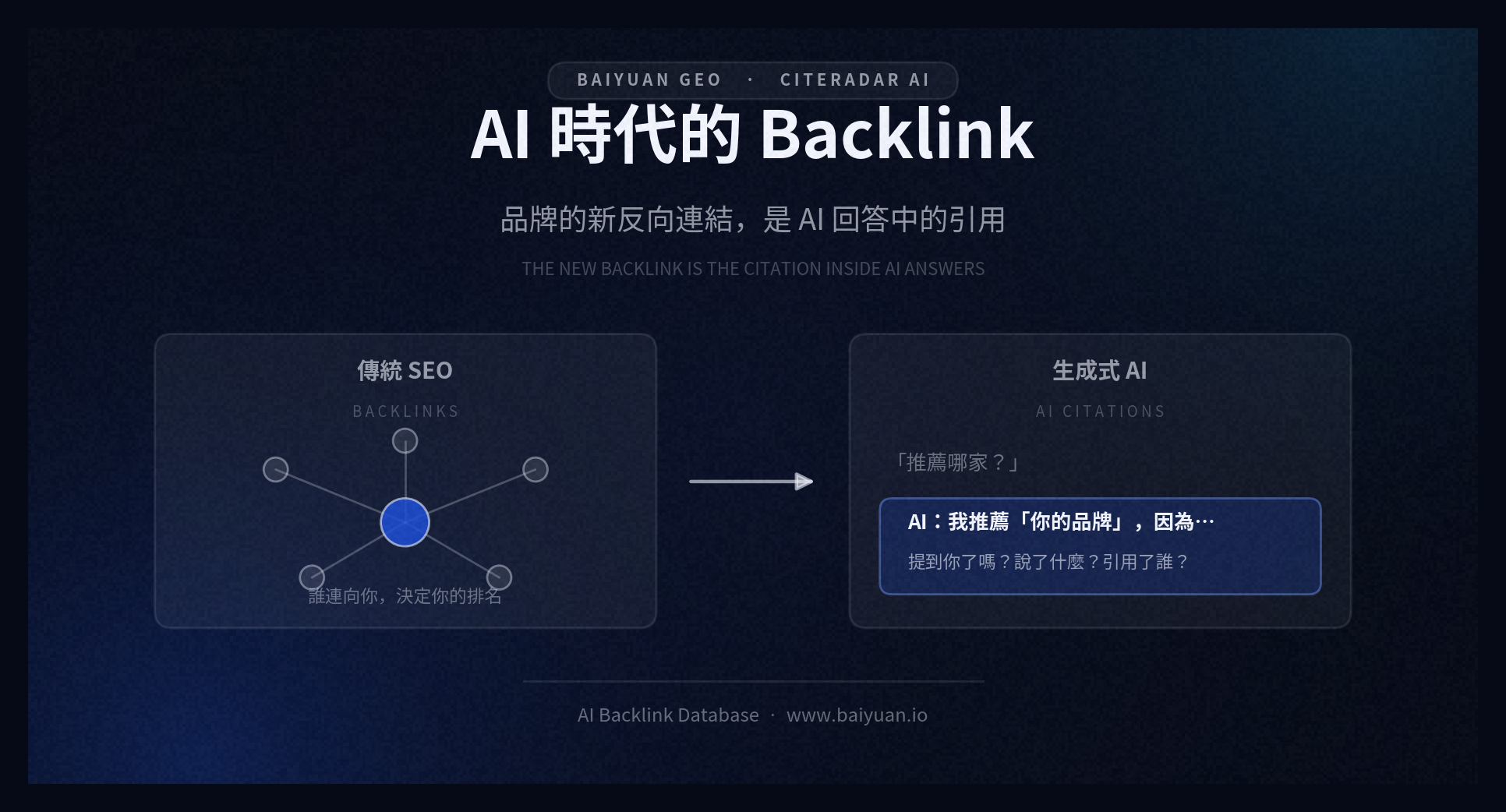
Traditional SEO ranks you by backlinks. In the generative AI era, your brand's new backlink is the citation inside AI answers.
When customers ask ChatGPT, Claude or Qwen "which brand do you recommend" — does AI mention you? What does it say? Whom does it cite? That citation evidence decides your visibility in the AI world.
Anyone who has done SEO knows this word
If you have ever run a website, you know the word backlink. It has been the single most important currency of the search-engine era: every link pointing from someone else's site to yours is a vote of trust. Google's PageRank turned that into an iron law — who links to you, how many link to you, and how authoritative those sites are decides where you stand in the results page.
For two decades an entire industry grew around earning those votes: link exchanges, guest posts, media coverage, directory listings. Tooling followed — Ahrefs, Moz, Semrush are, at their core, backlink databases: they crawl the web's link graph, archive it, score it, and tell brands how many votes they and their competitors hold.
The logic worked so well, for so long, that many people have not noticed: its premise is dissolving.
When AI answers directly, where did the links go?
Generative AI did not change the ranking rules — it changed the shape of the answer itself. A user asks ChatGPT "which serum is good for sensitive skin" and gets, instead of ten blue links, a paragraph of natural language: the AI names two or three brands, explains why, and the conversation ends. Most users never click a link. Often there is no link to click.
In this world, the trust votes still exist — but they are cast somewhere else. The question a brand must ask shifts from "who links to my website" to:
- Does AI mention you? In your customers' prompts, does your brand appear at all — or do competitors own the entire answer?
- What does AI say? Is the description accurate, or does it carry hallucinations — outdated prices, a wrong country of origin, product lines that never existed?
- Whom does AI cite? Which sites does the answer stand on — your official site, Wikipedia, news coverage, or a forum thread from five years ago?
The answers to these three questions are your brand's new backlinks in the AI world — we call them AI backlinks: citations inside AI answers. Like traditional backlinks they are votes of trust, but the voter is no longer a webmaster. It is the model itself.

Note the last row of the table: traditional backlinks take effect in weeks or months, while AI citations are bound to model retraining and retrieval-update cycles. Once the citation landscape solidifies, the correction window is longer than in SEO — the later you start, the larger the compounding disadvantage.
The problem: you cannot see your own AI backlinks
Traditional backlinks have mature tooling. AI citations are another story. Search Console will not tell you how ChatGPT described you today; Ahrefs cannot crawl whom Claude cited in its answer; and for brands outside China, the mainstream Chinese models — Qwen, Kimi, GLM — are a complete black box.
In our Existence Gap study we measured the scale of this blind spot: roughly nine out of ten Taiwanese SMEs simply do not exist in mainstream AI answers — not spoken ill of, just never mentioned at all. And among the brands that are mentioned, a meaningful share carries hallucinations the brand itself has never seen.
What you cannot see, you cannot manage. So the first step of operating AI backlinks is not rushing to publish content — it is establishing measurement, exactly as you would open Ahrefs before planning an SEO campaign.
One AI backlink report should answer five questions
Turning "how AI cites you" into manageable evidence requires systematically answering five questions:

- Which AI cites you (AI Authority): send real prompts to mainstream AI platforms and measure how often your brand is mentioned, in what position (first choice or afterthought), and with what sentiment.
- Which prompts mention you (Prompt Visibility): locate the scenarios where AI recommends you — and the scenarios where you are entirely absent. Every absence is a battlefield your competitors are already harvesting.
- Which sites AI cites most (Citation Graph): AI answers stand on sources. Identify the high-authority citation nodes your industry's AI trusts, and you know where your content belongs first.
- What enters AI knowledge bases (AI Ingestion): monitor how Wikipedia, news outlets and communities — the sources AI training and retrieval feed on — index your brand. That decides whether the next model generation "natively" knows you.
- How much AI hallucinates about you (LLM Trust Score): what share of AI's description of you is wrong, where, and how severely?
Together these five dimensions form your brand's citation evidence base in the AI world — the counterpart of the backlink database of the old one.
Baiyuan CiteRadar AI: your brand's AI Backlink Database
This is exactly what "Baiyuan CiteRadar AI", a sub-service of the Baiyuan GEO platform, does. Its category positioning is an AI Backlink Database: what Ahrefs is to links, Baiyuan CiteRadar AI is to citations — continuously collecting and archiving the evidence of how AI cites your brand.
It is built on Baiyuan GEO's existing monitoring engine and covers major AI platforms worldwide: ChatGPT, Claude, Gemini, Perplexity, DeepSeek, Google AI Overview, Grok and Meta AI globally — plus the mainstream Chinese models that almost no Western or Taiwanese tool covers: Qwen, GLM-4, Kimi and MiniMax, with more coming online. For brands operating across both markets, or whose supply-chain customers span China, this exclusive coverage is often the deciding factor.

Worth stressing: this engine is not a proof of concept. The hallucination detection behind the LLM Trust Score draws on 3,366+ real detected hallucination cases and an 86% auto-remediation rate — production numbers accumulated while serving real Baiyuan GEO customers, not lab benchmarks.
Consultant-operated: you only read the reports
Unlike the usual SaaS "buy a seat, learn the tool" model, Baiyuan CiteRadar AI is consultant-operated: discovery interview → consultant setup → continuous scanning → report delivery, all four steps run by the Baiyuan team. Your brand learns no tooling and simply reviews and downloads reports. Detailed data is retained for 12 months and trend data long-term — enabling year-over-year comparison and long-horizon narrative tracking.

An always-on reputation engine: from snapshots to curves
Many brands picture AI monitoring as a one-off health check. But AI narratives are not static — model releases, news events and retrieval updates can change how AI describes you overnight. A single snapshot tells you what AI says today; it cannot tell you which direction the narrative is heading. That is why Baiyuan CiteRadar AI is designed as an always-on reputation engine: it keeps scanning multiple major platforms at the agreed cadence and archives every instance of "how AI talks about you" into the evidence base — stretch the timeline, and the report turns from a snapshot into a curve.
- Sentiment and narrative analysis: every citation is measured for mention frequency, position and sentiment. The moment AI starts describing your brand negatively — or citing incorrect information — you see it in the report first. It is the reputation early-warning system of the AI era.
- Every piece of evidence is traceable: citations carry their source, timestamp and author, and can be cross-referenced — solid enough to support PR clarifications or legal action, instead of an unverifiable "AI apparently said something".
- Trends retained long-term: detail and trend data are tiered (see the previous section), supporting year-over-year comparison and narrative-direction tracking.

This is not theory — the GEO platform hosts a public live demo, "Celebrity Reputation Field Test": real Baiyuan CiteRadar AI scans of public figures, where you can see exactly which AI cites them, which sources it draws on, and the provenance and timestamp of every piece of evidence. See for yourself: geo.baiyuan.io/citeradar/demo.
Monitoring vs. remediation: Baiyuan CiteRadar AI or the GEO plan?
Baiyuan CiteRadar AI deliberately confines itself to monitoring and evidence: it tells you how AI cites you, where it hallucinates, and where you are absent — but includes no content remediation or deployment. When you need hallucinations fixed and absences filled, you can upgrade seamlessly to the GEO platform plan, where the closed-loop engine remediates content automatically and deploys authoritative sources.
Who should start with Baiyuan CiteRadar AI? Mid-to-large brands that already have a marketing team and lack only the AI perspective. Typical scenarios:
- Annual brand review: make "how AI describes us" a standing chapter of the yearly brand audit;
- PR incident monitoring: after a crisis, track how long AI narratives take to reflect your clarification;
- Product launch observation: measure how quickly a new product becomes known to AI, and who cites it;
- AI reputation monitoring: track citation trends and sentiment across multiple major platforms over the long run.
The service is reservation-based and quoted case by case according to brand size and monitoring scope; consultations are open now.
So how do you earn AI backlinks?
Measurement is only the starting point. After reading the report, the natural question is: how do I get AI to cite me more often, and more accurately? Traditional backlinks were earned through exchanges and outreach; AI citations have no such shortcut — models accept no link swaps, they only recognise credibility. In practice there are three paths, each mapping to a report dimension:
- Cultivate high-authority citation nodes: the Citation Graph tells you which sites your industry's AI trusts most — specific media, industry associations, comparison sites. Concentrating PR and content there beats scattering a hundred posts. This echoes what we argued in The Essence of GEO: one deep piece inside an authoritative node outweighs a million astroturfed posts.
- Write yourself into AI's knowledge base: the sources AI Ingestion monitors — Wikipedia, news databases, structured-data sources — are the raw material of model training and retrieval. Your site's structured data (Schema.org) and correct third-party listings decide what the next model generation natively believes about you.
- Fix hallucinations before expanding: if the LLM Trust Score shows AI describes you incorrectly, fix that first — wrong narratives replicate and amplify across model iterations. This is the typical moment to upgrade from Baiyuan CiteRadar AI to the GEO platform plan.
In other words, operating AI backlinks is not about volume. It is about placing accurate, structured, verifiable brand facts at every entrance AI trusts — and the report's value is turning that work from guesswork into coordinates.
Closing: you must see it before you can change it
Back to the opening line: your brand's new backlink is the citation inside AI answers. That is not a slogan — it is a measurement proposition. In the old world you managed link equity with a backlink database; in the AI world you need an AI Backlink Database to manage citation equity.
In our field experience, the first reaction of most brands seeing their AI citation report is: "so that is how AI talks about us." Some discover they are entirely absent from their most valuable purchase scenarios; others find AI has been citing an article that was taken down years ago. These facts were always there — no one could see them. Seeing is where every change begins.
Want to know how AI cites your brand today? Book a Baiyuan CiteRadar AI consultation at geo.baiyuan.io/citeradar, or start with the free 60-second AI visibility check at geo.baiyuan.io/diagnose.